
This post contains affiliate links. If you sign up for a product through one of these links, we may earn a commission at no extra cost to you. See our Affiliate Disclosure for details.
BigCommerce overhauled its entire pricing structure on June 1, 2026 — new plan names, lower revenue thresholds, and a new transaction fee that didn’t exist before. If you’re comparing Shopify vs BigCommerce right now, a lot of what’s written online is already out of date. Here’s an accurate, current breakdown of both platforms for small business sellers.
Key Takeaways
- BigCommerce renamed and restructured its plans in June 2026: Standard, Plus, Pro, and Enterprise are now Core, Growth, Scale, and Performance, with lower revenue thresholds than before.
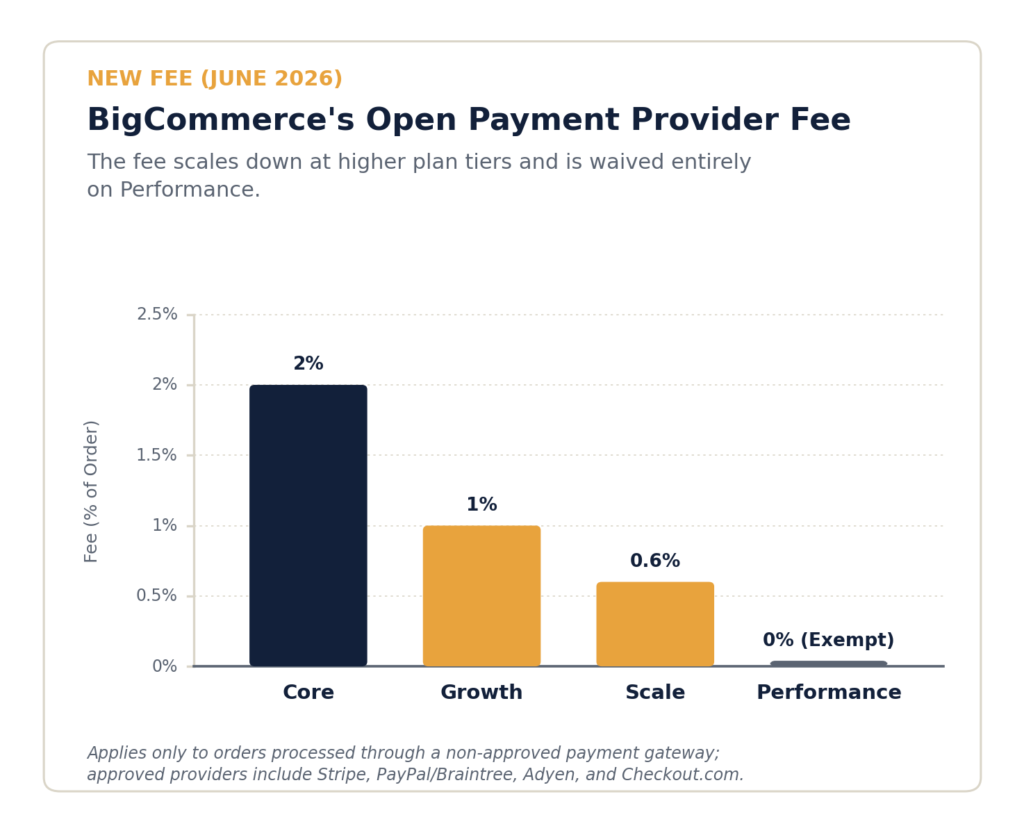
- BigCommerce added a new transaction fee: the Open Payment Provider Fee charges up to 2% on orders through a non-approved payment gateway — a cost that didn’t exist before mid-2026.
- Entry-level pricing is nearly identical: both sit at $39/month, so the real differentiator isn’t the sticker price.
- BigCommerce forces plan upgrades based on revenue; Shopify doesn’t. A fast-growing store can get pushed into a pricier BigCommerce tier without needing its extra features.
- Shopify has a larger app ecosystem; BigCommerce includes more natively. Which one saves you money depends on how many paid apps your store actually needs.
Jump to a section
Shopify vs. BigCommerce: The Short Answer
For most small sellers just starting out, Shopify is the simpler, more predictable choice — flat pricing regardless of revenue, and the largest app ecosystem if you need to add functionality later. BigCommerce is worth a serious look if you want more built-in features at the entry tier and don’t mind revenue-based plan thresholds, but its June 2026 pricing changes make it important to model your actual costs before committing, especially around payment processing.
BigCommerce’s June 2026 Pricing Overhaul, Explained
New Plan Names and Lower Revenue Thresholds
BigCommerce renamed every plan as part of this update: Standard became Core, Plus became Growth, Pro became Scale, and Enterprise became Performance. Base prices at the lower tiers didn’t change, but the annual sales thresholds that trigger a forced upgrade dropped — Core’s revenue cap fell from $50,000 to $30,000, and Growth’s fell from $180,000 to $100,000. A store growing steadily can hit these lower ceilings and get pushed into a pricier tier sooner than it would have under the old structure.
Also considering a self-hosted option? See our Shopify vs WooCommerce cost breakdown.
The New Open Payment Provider Fee
This is the change worth paying closest attention to. BigCommerce now charges a fee on any order processed through a payment gateway that isn’t on its approved “Embedded Payment Providers” list (which includes Stripe, PayPal/Braintree, Adyen, and Checkout.com, among others). The fee is 2% on Core, 1% on Growth, and 0.6% on Scale — Performance is exempt. If your store already uses one of the approved embedded providers, this fee simply doesn’t apply to you. If you use anything outside that list, it’s a real new cost that wasn’t there before mid-2026.
Editor’s Note
Before assuming BigCommerce’s new fee applies to you, check whether your payment gateway is on their approved Embedded Payment Providers list. If it is, this entire fee is a non-issue for your store.
Pricing Comparison: Shopify vs. BigCommerce in 2026
Shopify’s Plan Structure
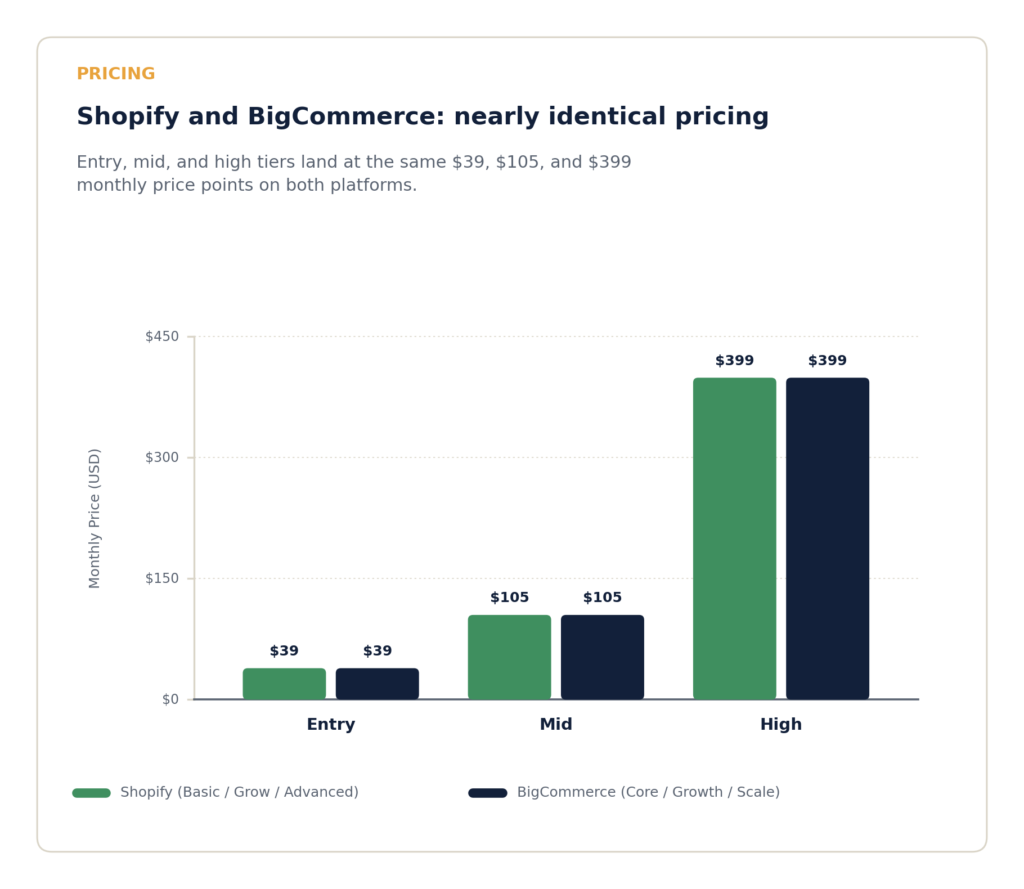
Shopify’s plans run Basic ($39/mo), Grow ($105/mo), Advanced ($399/mo), and Plus ($2,300+/mo), with a $5/mo Starter tier for social-selling-only setups. Critically, Shopify doesn’t force plan upgrades based on revenue — a store can stay on Basic indefinitely regardless of how much it sells, though higher tiers unlock better shipping rates and reporting that many growing stores eventually want anyway.
BigCommerce’s Plan Structure
BigCommerce’s renamed plans run Core ($39/mo), Growth ($105/mo), and Scale ($399/mo), with Performance custom-priced (typically starting around $1,499/mo). Unlike Shopify, BigCommerce ties plan tier to revenue — cross a plan’s GMV threshold and you’re moved to the next tier automatically, whether or not you need its additional features.
Where the Sticker Prices Actually Land
At the entry level, Shopify Basic and BigCommerce Core are both $39/month — essentially identical. The real cost difference shows up in three places: BigCommerce’s revenue-based forced upgrades, the new Open Payment Provider Fee if you’re not on an approved gateway, and how many paid third-party apps each platform requires you to add to match the other’s built-in features.
Feature Comparison: What Each Platform Includes
What BigCommerce Includes at Lower Tiers
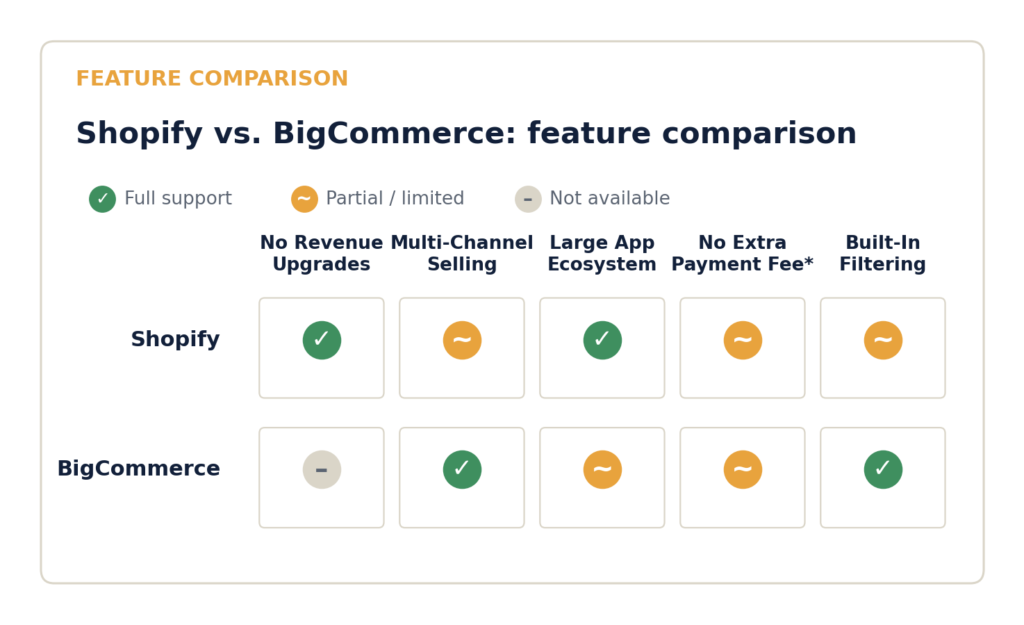
BigCommerce’s Core pricing plan includes several features that cost extra as paid apps on Shopify: built-in multi-channel selling to Amazon and eBay, a more capable native discount/coupon engine, and no forced app purchase for basic product filtering. For a seller who wants more out-of-the-box functionality without adding apps, this can mean a lower real-world cost than the subscription price alone suggests.
What Shopify Includes That BigCommerce Doesn’t Match as Easily
Shopify’s biggest advantage is ecosystem size — the Shopify App Store has far more third-party apps and integrations than BigCommerce’s marketplace, which matters if your store needs a specific niche tool. Shopify’s advantage over BigCommerce is that their checkout is also widely considered best-in-class for conversion rate, and Shopify Payments’ rate structure is simpler to reason about than BigCommerce’s new tiered Open Payment Provider Fee.
Which Platform Fits Your Business
Choose Shopify If You Want Predictable Pricing Regardless of Growth
You’d rather not think about revenue thresholds triggering plan changes. Shopify’s flat pricing model is simpler to budget around long-term, especially for a store with unpredictable or seasonal sales spikes.
You’re comfortable modeling your GMV against BigCommerce’s thresholds and already using one of its approved embedded payment providers. Core plan packs in more native functionality than Shopify Basic for the same $39/month.
Check out Shopify’s flat pricing model for more information.
Frequently Asked Questions About Shopify vs. BigCommerce
Did BigCommerce Pricing Change in 2026?
Yes. On June 1, 2026, BigCommerce renamed its plans (Standard, Plus, Pro, and Enterprise became Core, Growth, Scale, and Performance), lowered the revenue thresholds that trigger forced plan upgrades, and introduced a new Open Payment Provider Fee of up to 2% on orders processed through non-approved payment gateways.
Is Shopify or BigCommerce Cheaper for a Small Business?
At the entry tier, both platforms cost $39/month, making them essentially tied on sticker price. The real cost difference depends on your payment gateway, your revenue growth trajectory, and how many paid apps you need to match features the other platform includes natively.
Does Shopify Charge a Transaction Fee Like BigCommerce’s New Fee?
Shopify charges an additional fee (up to roughly 2% on lower-tier plans) if you use a third-party payment gateway instead of Shopify Payments — conceptually similar to BigCommerce’s new fee, though structured somewhat differently. Using each platform’s own native payment processor avoids the extra fee on both.
Can I Avoid BigCommerce’s New Open Payment Provider Fee?
Yes, by processing orders through one of BigCommerce’s approved Embedded Payment Providers, which includes Stripe, PayPal/Braintree, Adyen, and Checkout.com among others. If your store already uses one of these, the new fee doesn’t apply to your orders at all.
Bottom Line: Shopify vs. BigCommerce for Small Business
Bottom Line
Both platforms land at the same $39/month entry price, so this decision comes down to your specific setup rather than sticker price. If you want predictable pricing that doesn’t shift with your revenue, Shopify is the safer long-term bet. If you want more built into the base plan and you’re already using an approved payment gateway, BigCommerce’s Core plan is genuinely competitive — just model your GMV against its thresholds before committing.
Have questions about migrating between platforms, or a specific cost scenario you’d like modeled? Reach out at contact@ecomfundingguide.com.
How We Researched This Comparison
We pulled current 2026 pricing directly from Shopify’s and BigCommerce’s own pricing pages — including BigCommerce’s June 2026 changes — and weighed the following when building this breakdown:
2 thoughts on “Shopify vs. BigCommerce: A Small Business Buyer’s Guide”