
This post contains affiliate links. If you sign up for a product through one of these links, we may earn a commission at no extra cost to you. See our Affiliate Disclosure for details.
Manual inventory tracking works fine until it doesn’t — usually right around the time you’re selling across more than one channel, or a spreadsheet typo causes you to oversell a product that’s actually out of stock. Below are seven of the best inventory management tools that genuinely fit small e-commerce operations in 2026, based on current pricing and what each one is actually built for.
Key Takeaways
- Best overall value: Zoho Inventory offers a genuinely usable free tier and affordable paid plans starting at $39/month, with strong Shopify and WooCommerce integrations.
- Best for simplicity: inFlow Inventory prioritizes ease of use over deep customization, suiting sellers who don’t want a steep learning curve.
- Best for multichannel sellers: Cin7 Core is built specifically for syncing inventory across several sales channels at once, though it costs more.
- Best free option: Veeqo (owned by Amazon) offers a genuinely free plan with unlimited users and orders, with a tradeoff around shipping label requirements.
- Don’t over-buy: Manufacturing-focused tools like Katana add production features most resellers don’t need — match the tool to whether you make products or resell them.
Jump to a pick
Best Inventory Management Tools for Small E-Commerce: The Short Answer
For most small e-commerce sellers, Zoho Inventory offers the strongest combination of price and features, especially if you’re already selling on Shopify or WooCommerce. Cin7 Core is worth the higher cost once you’re managing inventory across three or more sales channels. Veeqo is the best genuinely free option if you sell primarily through Amazon. Sellers who manufacture or assemble products, rather than resell them, should look at Katana instead of a general reseller-focused tool.
Feature Comparison: All Seven Tools Side by Side
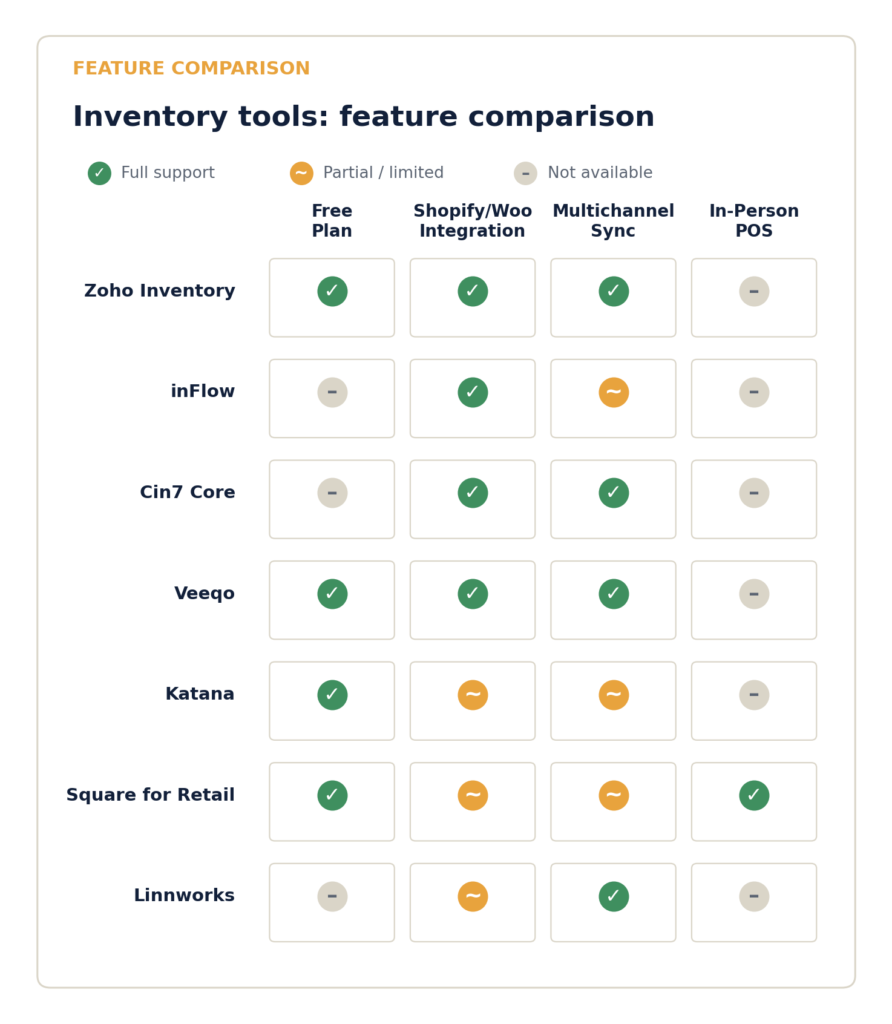
The 7 Best Inventory Management Tools
Zoho Inventory: Best Overall Value
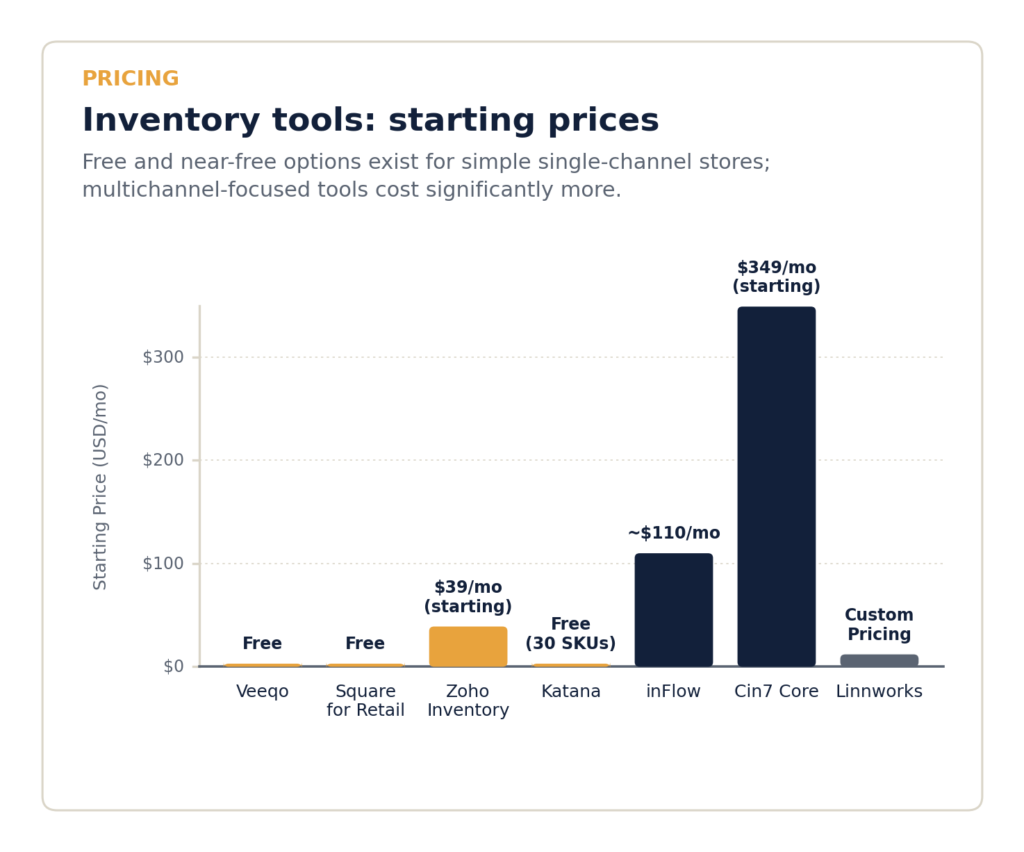
Zoho Inventory offers a genuinely usable free plan (up to 50 orders/month, 1 user, 2 locations) and scales into affordable paid tiers: Standard at $39/month, Professional at $99/month, Premium at $159/month, and Enterprise at $299/month, all with a 20% discount for annual billing. It integrates directly with Shopify, WooCommerce, BigCommerce, Amazon, and eBay, and connects natively to Zoho’s own accounting software if you’re already in that ecosystem.
Best for: Small sellers who want strong e-commerce integrations without paying enterprise prices.
Check out Zoho’s official pricing page for more information.
inFlow Inventory: Best for Simplicity
inFlow is built around ease of use rather than deep customization, with pricing around $110/month on an annual plan. It covers the core needs — stock tracking, purchase orders, barcode scanning — without the steeper learning curve of more feature-dense platforms.
Best for: Sellers who want something straightforward without a long onboarding process.
Cin7 Core: Best for Multichannel Selling
Cin7 Core is built specifically for syncing inventory in real time across multiple sales channels and warehouses, starting around $349/month. It’s a meaningfully higher price point than the other tools on this list, which makes sense once you’re managing enough order volume and channel complexity to justify it — not before.
Best for: Growing stores selling across three or more channels simultaneously.
Veeqo: Best Free Option
Veeqo, owned by Amazon, offers a free plan with unlimited users, orders, and warehouses — a rare structure among inventory tools, most of which cap free tiers tightly. The tradeoff: roughly half of your shipping labels need to be purchased through Veeqo’s own rates to keep the free plan.
Best for: Amazon-heavy sellers who can work within Veeqo’s shipping label requirement.
Check out Veeqo’s own rates to keep the free plan.
Katana Cloud Inventory: Best for Manufacturers and Makers
Katana is built for businesses that make or assemble products rather than resell them, with a visual production scheduler and bill-of-materials management. It offers a limited free plan covering 30 SKUs and 3 locations, with paid plans scaling from there.
Best for: Makers and small manufacturers, not straightforward resellers.
Square for Retail: Best for Hybrid Online/In-Person Sellers
Square for Retail includes a genuinely free plan with inventory tracking, low-stock alerts, and barcode scanning, with paid tiers adding purchase order management and more detailed reporting. Its biggest strength is syncing inventory between an online store and a physical point-of-sale system in one platform.
Best for: Sellers who split volume between an online store and in-person sales.
Linnworks: Best for Warehouse-Level Accuracy
Linnworks (which acquired SkuVault) focuses on warehouse-floor accuracy — barcode-verified picking, packing, and shipping designed to virtually eliminate mis-picks and wrong-item shipments. Pricing is generally higher and less publicly transparent than the other tools here, typically requiring a quote based on order volume.
Best for: Sellers with enough order volume that warehouse picking errors are a real, recurring cost.
Pricing at a Glance
How to Choose the Right Tool for Your Store
Match the Tool to Your Channel Count, Not Your Order Volume
A common mistake is picking a tool based on how many orders you process rather than how many channels you sell on. A single-channel Shopify store with 2,000 orders/month has simpler inventory needs than a 200-order/month store selling across Shopify, Amazon, and a physical popup — channel count drives complexity more than raw order volume does.
Reseller vs. Manufacturer Matters More Than It Seems
If you’re assembling, kitting, or manufacturing products rather than simply reselling what you buy, a reseller-focused tool like Zoho or inFlow will feel limiting fast. Tools like Katana that include bill-of-materials and production scheduling exist specifically for this case — don’t force a general inventory tool to do a manufacturing tool’s job.
Frequently Asked Questions About E-Commerce Inventory Management
What Is the Best Free Inventory Management Software for Small Business?
Veeqo offers the most generous genuinely free plan, with unlimited users, orders, and warehouses, though roughly half your shipping labels must go through Veeqo’s own rates. Zoho Inventory and Square for Retail both offer free tiers as well, though with tighter order/location limits.
Do I Need Separate Inventory Software If I Already Use Shopify?
Shopify’s native inventory tracking works fine for a single-channel store with a simple catalog. Dedicated inventory software becomes worth it once you’re selling across multiple channels, need purchase order management, or want barcode-verified warehouse accuracy that Shopify’s built-in tools don’t cover.
How Much Does Inventory Management Software Cost for a Small Business?
Small business inventory tools typically range from free to $150/month for core features, with multichannel-focused platforms like Cin7 Core starting closer to $349/month. Your actual cost depends heavily on order volume, number of sales channels, and whether you need warehouse-level features like barcode verification.
What’s the Difference Between Inventory Software and a POS System?
A POS system is built primarily for processing in-person transactions, with inventory tracking as a supporting feature. Dedicated inventory software is built primarily for stock accuracy, purchase orders, and multichannel sync, sometimes without any point-of-sale function at all. Some tools, like Square for Retail, blend both.
Bottom Line: Choosing an Inventory Tool for Your Store
Bottom Line
Start with Zoho Inventory or Veeqo if you’re a small, single-to-two-channel seller — both give you real functionality without a big monthly commitment. Move to Cin7 Core once channel complexity, not just order volume, starts costing you real time. And if you manufacture rather than resell, skip general inventory tools entirely and go straight to a maker-focused platform like Katana.
Using a tool that isn’t on this list? Reach out at contact@ecomfundingguide.com — we’re always comparing notes with real sellers.
How We Evaluated These Picks
We compare current, publicly listed pricing and features directly from each provider’s official site, and weigh the following when ranking picks:
1 thought on “7 Best Inventory Management Tools for Small E-Commerce Sellers”