
This post contains affiliate links. If you sign up for a product through one of these links, we may earn a commission at no extra cost to you. See our Affiliate Disclosure for details.
Generic small-business accounting software can technically work for an online store, but it wasn’t built for the specific mess e-commerce creates: marketplace fees buried inside payouts, multi-channel sales tax, and inventory costs that don’t map cleanly to a single transaction. Below is a real comparison of the best accounting software for e-commerce sellers to actually use in 2026, plus an often-missed distinction that can save you from buying the wrong thing.
Key Takeaways
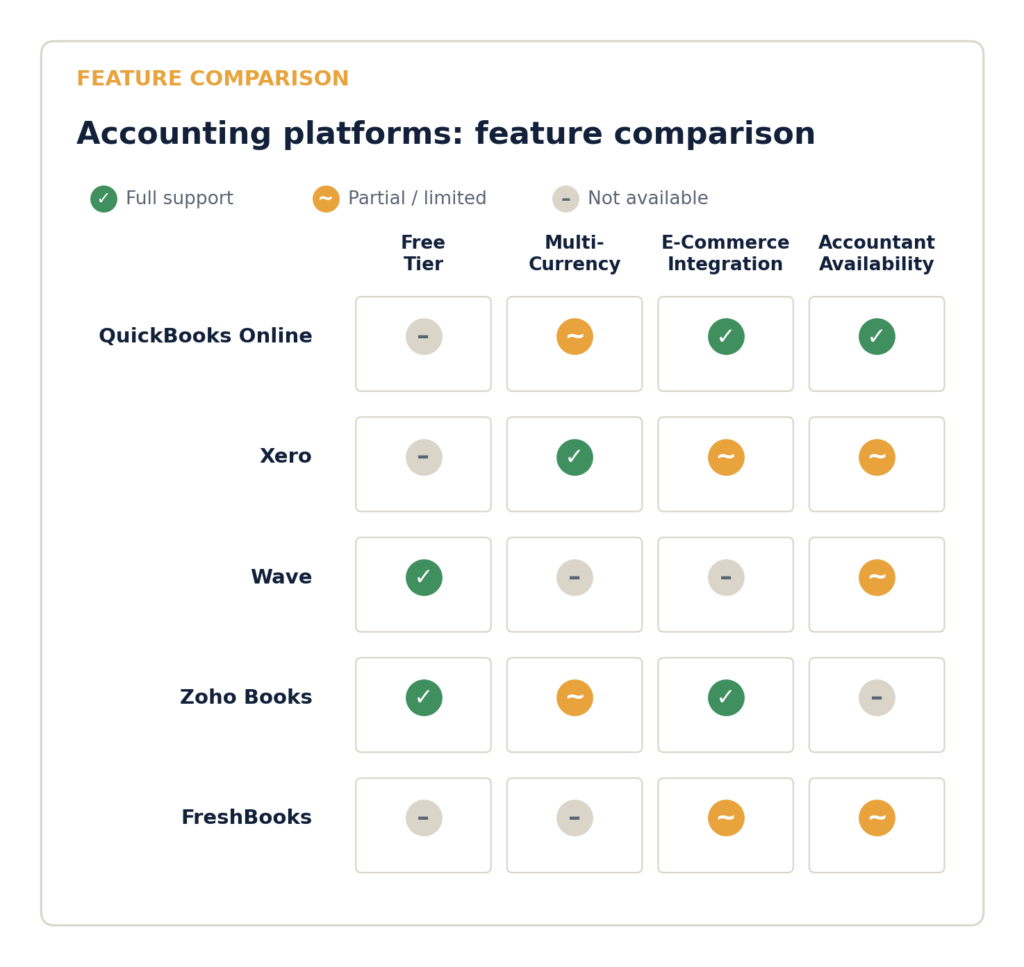
- Best overall: QuickBooks Online has the deepest e-commerce integration ecosystem and the largest network of accountants familiar with it, making it the safest default for US-based sellers.
- Best for international sellers: Xero handles multi-currency and cross-border VAT/GST more cleanly than QuickBooks.
- Best free option: Wave offers genuinely free core accounting, a solid fit under roughly $50K/year in revenue.
- Best value in an existing ecosystem: Zoho Books is free under $50K revenue and integrates directly with Zoho Inventory if you’re already using it.
- The most common mistake: buying a full accounting platform alone and expecting it to reconcile marketplace payouts — most sellers selling on 2+ channels need a connector app like A2X on top of, not instead of, their accounting software.
Jump to a pick
Best Accounting Software for E-Commerce: The Short Answer
For most US-based sellers, QuickBooks Online is the safe default — the largest integration ecosystem and easiest to find an accountant for. Xero is the better pick if you sell internationally or need multi-currency support. Wave or Zoho Books make sense if you’re pre-revenue or under roughly $50K/year and want to avoid a subscription entirely. Once you’re selling across more than one channel (Shopify + Amazon, for example), plan to add a reconciliation connector like A2X on top of whichever platform you choose — this is a separate cost most sellers don’t budget for upfront.
The Core Accounting Platforms
QuickBooks Online: Best Overall
QuickBooks Online offers the widest integration ecosystem and the deepest bench of accountants who already know it, which matters when you eventually hand off bookkeeping or need tax help. Pricing runs Simple Start at $35/month, Essentials at $65/month, Plus at $99/month, and Advanced at $235/month, with frequent promotional pricing available at signup. A lower-cost Solopreneur tier (around $20/month) also exists for very early-stage single-person sellers.
Best for: US-based sellers who want the largest ecosystem and easiest path to professional bookkeeping help later.
Xero: Best for International Sellers
Xero’s multi-currency handling and VAT/GST compliance are cleaner than QuickBooks’, which matters directly if you’re selling to customers outside the US or sourcing internationally. Entry pricing starts around $25/month (Early plan), scaling up to around $55/month (Growing) as you need more invoices and bill entries per month.
Best for: Sellers with meaningful international sales or multi-currency needs.
Wave: Best Free Option
Wave’s core accounting (invoicing, expense tracking, basic reporting) is genuinely free, not a limited trial — a real option for bootstrapped sellers under roughly $50K/year. The tradeoff: no built-in inventory tracking, and channel imports are more manual than the paid options.
Best for: Very early-stage or low-volume sellers who want to avoid a monthly subscription entirely.
Zoho Books: Best Value Inside the Zoho Ecosystem
Zoho Books is free under $50K in annual revenue and integrates natively with Zoho Inventory (covered in our inventory management roundup) if you’re already in that ecosystem — a meaningful convenience if you picked Zoho for inventory already.
Best for: Sellers already using Zoho Inventory, or anyone wanting one connected ecosystem instead of stitching tools together.
FreshBooks: Best for Simple, Single-Channel Operations
FreshBooks isn’t built with the same e-commerce depth as QuickBooks or Xero, but its invoicing and expense tracking are simpler to use for straightforward, single-channel DTC operations that don’t need heavy multi-channel reconciliation.
Best for: Simple, single-channel sellers who find QuickBooks or Xero more complexity than they need.
Why You Might Need a Connector App Too
The Problem Full Accounting Platforms Don’t Solve Alone
None of the platforms above natively separate a marketplace payout into its actual parts — sales, fees, refunds, shipping, and tax all arrive bundled into one deposit from Shopify or Amazon. Recording that whole deposit as “revenue” quietly misstates your books every single payout cycle.
A2X and Synder: What They Actually Do
A2X and Synder aren’t accounting software — they’re connector apps that sit between your sales channels and QuickBooks or Xero, automatically breaking each payout into its correct components before it hits your books. A2X is priced per connected channel, commonly starting around $29/month per channel; Synder’s pricing scales with transaction volume, starting around $16/month for lower-volume sellers.
When You Actually Need One
Below roughly $50K/year on a single channel, manual reconciliation is usually tolerable without a connector app. Once you’re selling across two or more channels, or your monthly order volume makes manual reconciliation a multi-hour chore, a connector app typically pays for itself in time saved alone — separate from the accuracy problem it also solves.
Editor’s Note
Don’t budget for accounting software alone if you sell on 2+ channels. A2X (or Synder) is a separate, ongoing cost most sellers forget to plan for until their books are already a mess.
Real Cost by Revenue Stage
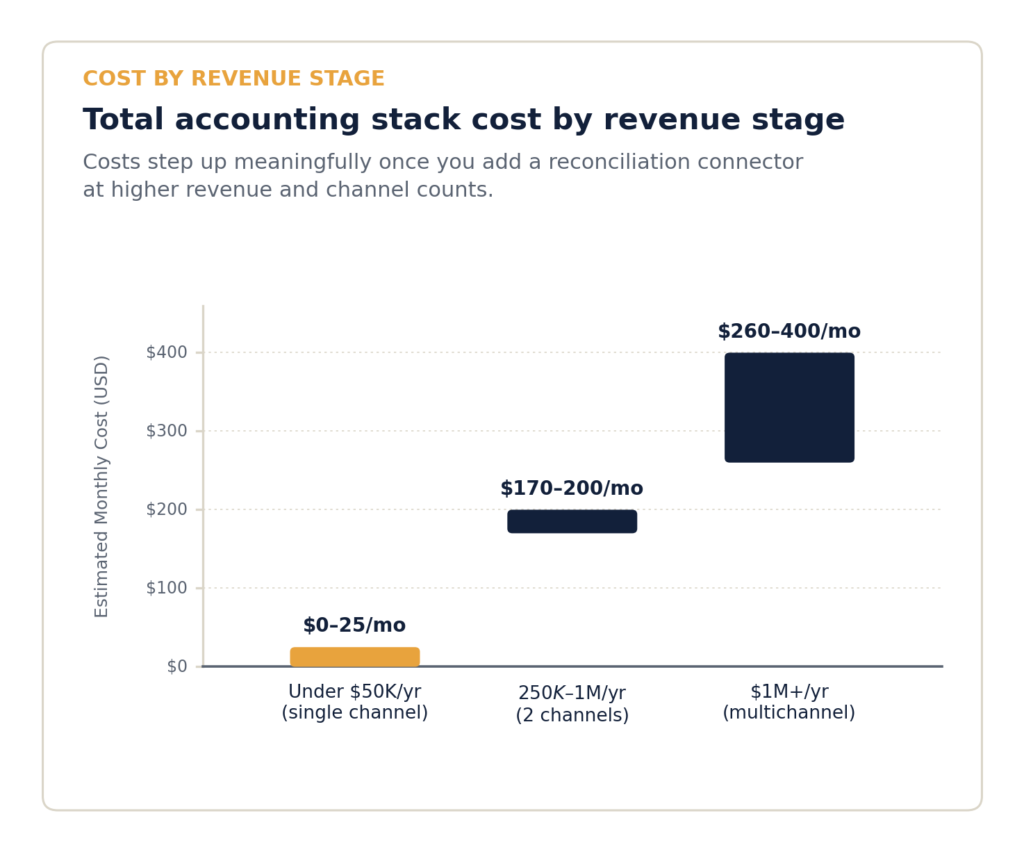
A rough guide to what sellers actually pay, all-in:
Good bookkeeping also matters if you’re applying for financing — lenders will want to see clean books.
Frequently Asked Questions About E-Commerce Accounting Software
What Is the Best Free Accounting Software for E-Commerce?
Wave offers genuinely free core accounting with no revenue cap, though it lacks built-in inventory tracking. Zoho Books is also free specifically under $50K in annual revenue, and includes tighter integration if you’re already using Zoho Inventory.
Do I Need QuickBooks and A2X, or Just One of Them?
Both, if you sell on more than one channel. QuickBooks (or Xero) is your actual accounting system of record; A2X is a connector that feeds accurate, itemized data into it from your sales channels. Neither replaces the other — A2X specifically exists to solve a problem QuickBooks and Xero don’t handle natively.
Is Xero or QuickBooks Better for E-Commerce?
QuickBooks has the larger integration ecosystem and accountant familiarity, making it the safer default for most US sellers. Xero is generally the better choice specifically for international sellers, thanks to stronger multi-currency and VAT/GST handling.
How Much Should a Small E-Commerce Business Budget for Accounting Software?
Very early-stage single-channel sellers can realistically spend $0–25/month. Once you’re selling across multiple channels at meaningful volume, budget $150–400/month for a combined accounting platform and reconciliation connector, depending on channel count and order volume.
Bottom Line: Choosing Accounting Software for Your Store
Bottom Line
Start with QuickBooks Online if you’re US-based and want the safest, most supported default — or Wave if you want to avoid a subscription entirely while you’re small. The bigger mistake to avoid isn’t picking the “wrong” platform, it’s assuming your accounting software alone will correctly handle multi-channel payouts. Once you’re selling on more than one channel, budget for a connector app like A2X from the start, not as an afterthought once your books are already a mess.
Have a stack that works well for your store? Reach out at contact@ecomfundingguide.com — we’re always comparing real seller setups.
How We Evaluated These Picks
We compare current, publicly listed pricing directly from each provider’s official site, and weigh the following when ranking picks: