
This post contains affiliate links. If you sign up for a product through one of these links, we may earn a commission at no extra cost to you. See our Affiliate Disclosure for details. This article is for informational purposes only and isn’t financial or legal advice — talk to a qualified lender or financial advisor before making a financing decision.
Most e-commerce financing questions aren’t really “how do I get money” — they’re “which type of money fits how my business actually gets paid.” A revenue-based advance that sweeps a percentage of daily sales works well for a fast-turning DTC brand and poorly for a business with long inventory cycles. Below is a current, realistic breakdown of the financing options for e-commerce businesses in 2026, and which situations each one actually fits.
Key Takeaways
- Fastest, easiest access: Shopify Capital, available only by invitation inside your Shopify dashboard, requires no application and repays as a fixed percentage of daily sales.
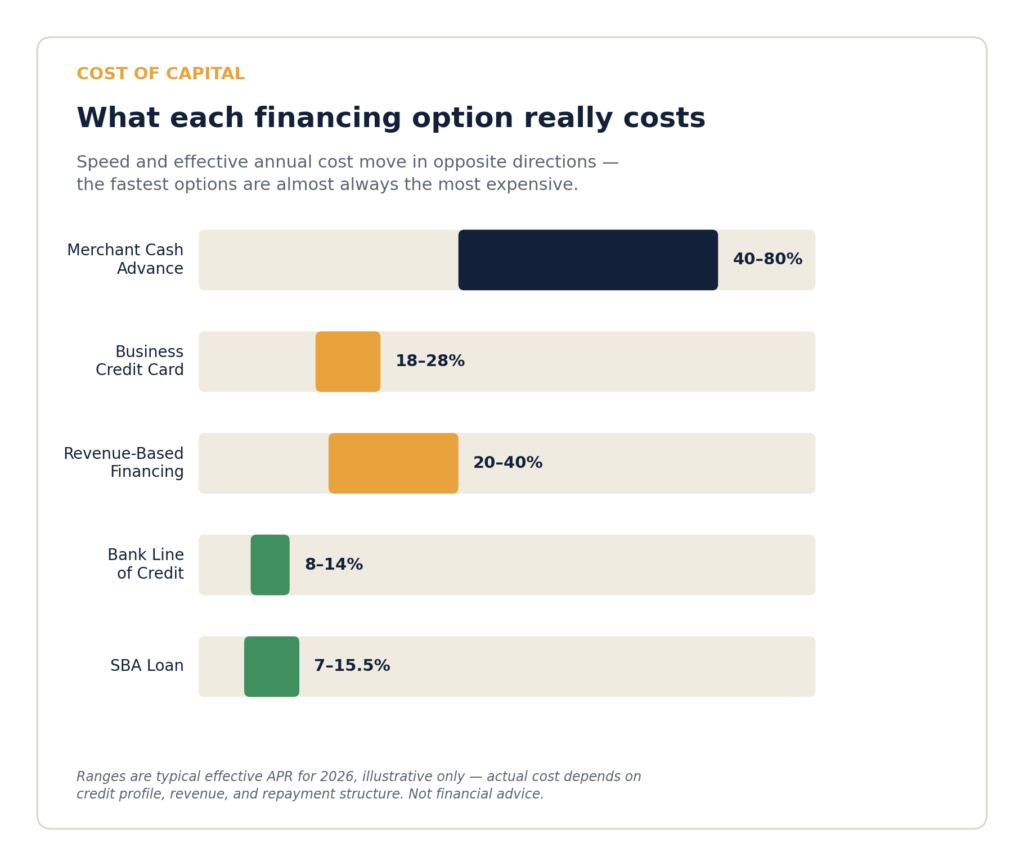
- Best rates if you qualify: SBA loans and traditional bank financing offer the lowest cost of capital (roughly 7-15% APR) but require strong credit, 2+ years in business, and a slower approval process.
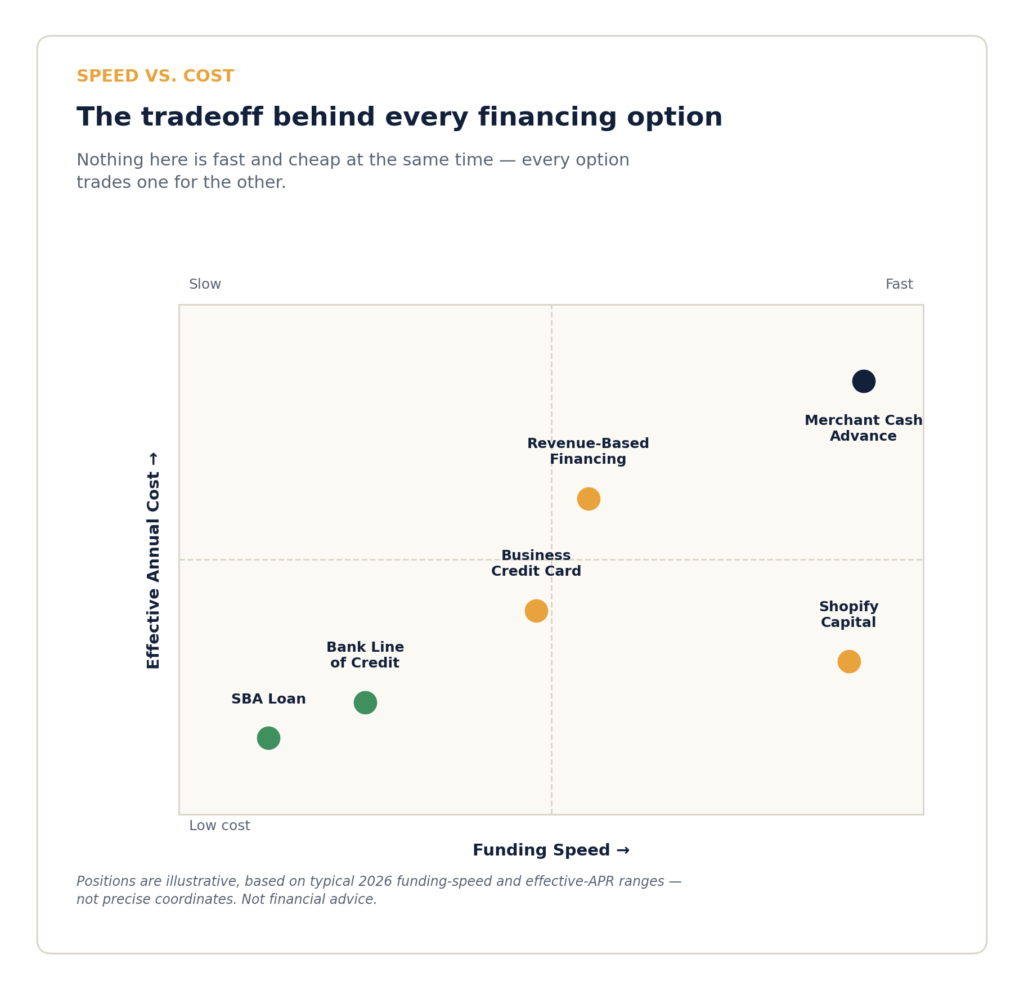
- Fastest-growing category for e-commerce: Revenue-based financing (Wayflyer, Clearco) ties repayment to sales, funds in 1-3 days, but carries a meaningfully higher effective cost than a bank loan.
- Avoid unless truly desperate: Merchant cash advances often carry the highest real cost of any option here, sometimes exceeding 50% effective APR once the terms are converted to an annual rate.
- The repayment structure matters more than the label: a “7% fee” and a “15% APR” aren’t directly comparable — always convert to an effective annual cost before deciding.
Jump to an option
Financing Options for E-Commerce: The Short Answer
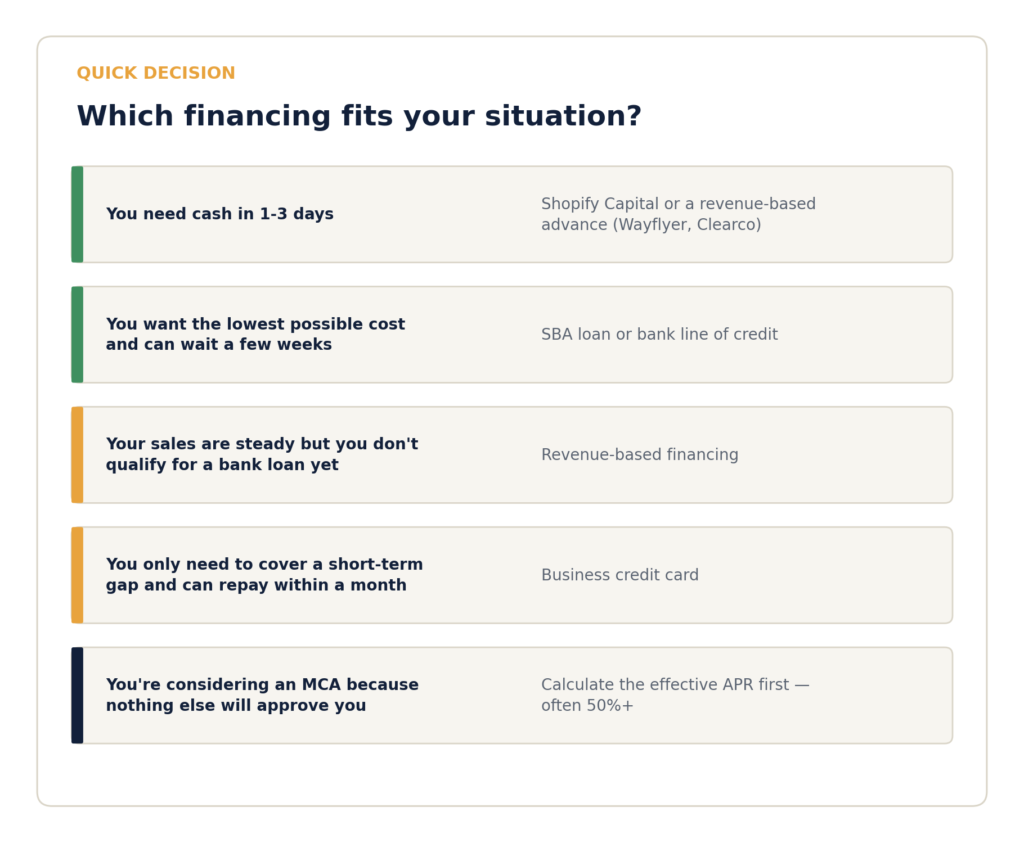
If you’re a Shopify seller with steady sales history, Shopify Capital is the simplest starting point since it requires no application. If you want the lowest cost of capital and can wait several weeks, an SBA loan or bank line of credit beats every alternative lender on price. If you need capital fast and are comfortable with revenue-based repayment, Wayflyer or Clearco are the established options built specifically for e-commerce. Merchant cash advances should generally be a last resort — the convenience comes at a real cost that’s easy to underestimate.
Revenue-Based Financing
How It Works
Revenue-based financing providers advance capital against your store’s sales history and collect repayment as a percentage of daily or weekly revenue, rather than a fixed monthly payment. This means repayment scales with your sales — you pay more in a strong month and less in a slow one — which is the main appeal over a fixed-payment loan.
Shopify Capital
Available exclusively to Shopify merchants who receive an invitation inside their Shopify admin, based on the store’s sales history. There’s no separate application; funding amounts and terms are pre-calculated and offered directly. Repayment happens automatically as a fixed percentage of daily sales.
Wayflyer and Clearco
Both are established revenue-based financing providers built specifically for e-commerce and DTC brands, connecting directly to Shopify, Amazon, or ad platform accounts to evaluate sales performance. Funding typically lands within 1-3 business days. Clearco generally requires around $10,000+ in monthly revenue and 12 months of sales history; Wayflyer’s funding range spans from $5,000 up to $20 million depending on business size. Both charge a flat fee (commonly in the 7-14% range per advance) rather than a traditional interest rate — worth converting to an effective APR before comparing against other options.
Traditional Financing: SBA Loans and Bank Lines of Credit
SBA Loans
SBA loans aren’t issued by the government directly — they’re made by regular banks, with a government guarantee that lowers the lender’s risk, which is why rates beat almost every alternative option. Current SBA 7(a) rates run roughly 10.5-15.5% APR. Minimum credit score requirements range from 575 for Microloans up to 680 for standard 7(a) and 504 loans, and anyone owning 20%+ of the business typically must personally guarantee the loan. Approval takes considerably longer than alternative lenders — often several weeks.
Business Lines of Credit
A revolving credit line lets you draw funds as needed and pay interest only on the amount actually drawn, rather than the full approved limit — a meaningful advantage over a term loan if your capital need is variable rather than a single lump sum. Bank-issued lines of credit run roughly 8-14% APR; online lenders run higher, around 12-22%; SBA CAPLine products sit in between at roughly 9-11.5%.
Business Credit Cards
The most accessible option for very new or lower-revenue stores, but also one of the more expensive — typical rates run 18-28% APR if you carry a balance. Best used for short-term working capital you can pay off monthly, not as a substitute for real growth financing.
Merchant Cash Advances: Proceed With Caution
Merchant cash advances offer fast, low-barrier access to capital, but they’re structured in a way that often obscures the real cost — a “factor rate” isn’t the same as an interest rate, and converting it to an effective APR frequently reveals costs of 50% or higher. If you’re considering an MCA, calculate the actual annualized cost before signing, and treat it as a genuine last resort rather than a first option.
How to Choose the Right Financing Option
Whichever option you choose, make sure your accounting setup can track it cleanly for tax time.
A revenue-based advance that sweeps daily sales works well for a fast-turning business with short inventory cycles, and poorly for a business with long production or shipping lead times where cash gets tied up for months. Map the repayment schedule against when your business actually has cash available.
A flat 8% fee repaid over 4 months costs far more annualized than an 8% fee repaid over 12 months. Don’t compare financing options by their advertised fee or rate alone — convert every offer to an effective annual percentage rate so you’re comparing the same thing.
Frequently Asked Questions About E-Commerce Financing
What Is the Cheapest Way to Finance an E-Commerce Business?
SBA loans and traditional bank lines of credit offer the lowest cost of capital, typically 7-15% APR, but require strong credit, time in business, and a slower approval process. If you don’t qualify for those, a bank-issued business line of credit is generally the next-cheapest option.
How Fast Can I Get E-Commerce Financing?
Shopify Capital, Wayflyer, and Clearco can all fund within 1-3 business days once approved. SBA loans and traditional bank financing typically take several weeks. Merchant cash advances can fund within hours but carry the highest typical cost of any option covered here.
Do I Need Good Credit for Revenue-Based Financing?
Revenue-based financing providers generally underwrite based on your store’s sales history and revenue rather than personal credit score, which is why they’re accessible to sellers who might not qualify for a traditional bank loan. That said, most do require a minimum revenue threshold and a track record of consistent sales.
What’s the Difference Between a Factor Rate and an APR?
A factor rate (common in merchant cash advances) is a multiplier, not a percentage — a 1.3 factor rate on a $10,000 advance means you repay $13,000 total. Converting a factor rate to an effective APR usually reveals a much higher true cost than the factor rate alone suggests, which is why it’s worth calculating before accepting any offer.
Bottom Line: Financing Your E-Commerce Business
Bottom Line
There’s no single best financing option — only the one whose cost and repayment structure actually fits your business’s cash flow. Start with the lowest-cost option you genuinely qualify for (SBA or bank financing), and treat revenue-based financing and merchant cash advances as tools for speed, not default choices. Whatever you choose, calculate the real annualized cost before signing anything, and consider talking to an accountant or financial advisor before committing to a financing decision that will affect your business for months or years.
Have a financing option that worked well for your store? Reach out at contact@ecomfundingguide.com — we’re always comparing real seller experiences.
How We Evaluated These Options
We pulled current 2026 rate ranges directly from lenders and providers, converting every offer to an effective annual cost before comparing, and weighed the following: