
This post contains affiliate links. If you sign up for a product through one of these links, we may earn a commission at no extra cost to you. See our Affiliate Disclosure for details.
Most Shopify stores don’t need a chatbot until they do — usually right around the point where “where is my order” questions start eating a real chunk of your week. Below is a current comparison of the best AI chatbots for Shopify sellers in 2026, from genuinely free to fully autonomous.
AI is showing up in more parts of running a store — see our take on AI inventory forecasting too.
Key Takeaways
- Best free option: Shopify Inbox is built in and costs nothing, a reasonable starting point under roughly 200 conversations a month.
- Best overall balance: Tidio’s Lyro AI combines a real free tier with affordable AI add-ons, covering FAQ and order-status questions well.
- Best for growing stores: Gorgias pairs AI automation with a full helpdesk, useful once support volume outgrows a simple chat widget.
- Best for high-volume automation: Richpanel offers a fully autonomous AI helpdesk, at a meaningfully higher price point.
- Don’t over-buy early: most stores under 200 conversations/month don’t need a paid AI chatbot yet — Shopify Inbox alone is usually enough until volume actually justifies the cost.
Jump to a pick
Best AI Chatbots for Shopify: The Short Answer
For very small stores, Shopify Inbox is free and genuinely sufficient until support volume grows. Tidio offers the best overall balance of price and real AI capability for small-to-mid stores. Gorgias makes sense once you need a full helpdesk, not just a chat widget. Richpanel is the right tool only once your ticket volume justifies a fully autonomous, higher-cost setup.
The AI Chatbot Options
Shopify Inbox: Best Free Option
Built directly into Shopify with no separate app required, Inbox handles basic chat and order lookups at no cost. It works well under roughly 200 conversations a month; beyond that, its lack of real AI deflection becomes a limiting factor.
Best for: Very small stores not yet dealing with high repeat-question volume.
Tidio (Lyro AI): Best Overall Balance
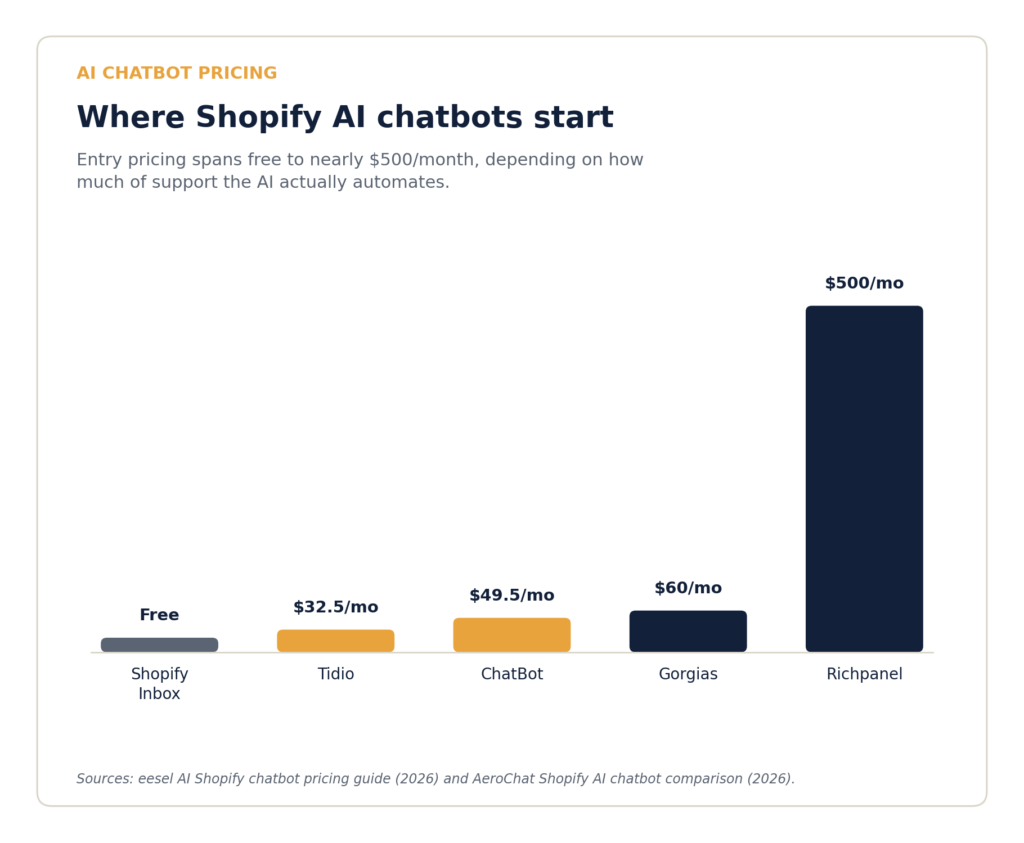
Tidio’s Lyro AI agent answers FAQ and order-status questions by learning from your store data and help content, with a genuine free plan and AI add-ons starting around $32.50/month for 50 AI conversations. It handles straightforward, repetitive queries well, though complex multi-step requests still need a human.
Best for: Small to mid-sized stores wanting real AI automation without a big budget commitment.
Gorgias: Best for Growing Stores
Gorgias combines AI automation with a full customer service helpdesk (tickets, macros, reporting), making it a better fit once support has outgrown a standalone chat widget and needs real workflow tools behind it.
Best for: Growing stores that need a complete support system, not just a chatbot.
Richpanel: Best for High-Volume Automation
Richpanel positions itself as a fully autonomous AI helpdesk, capable of resolving a high share of tickets without human involvement. Pricing runs meaningfully higher than the other options here, up to around $500/month, reflecting its more complete automation.
Best for: Higher-volume stores where ticket automation at scale justifies the cost.
ChatBot: Best Budget Builder Option
ChatBot offers a visual drag-and-drop builder for creating support flows, with a lower entry price but a per-resolution-pack cost structure (extra AI resolutions priced in 50-packs) that can add up if volume grows past your plan.
Best for: Budget-conscious stores comfortable building their own flows rather than relying on out-of-the-box AI.
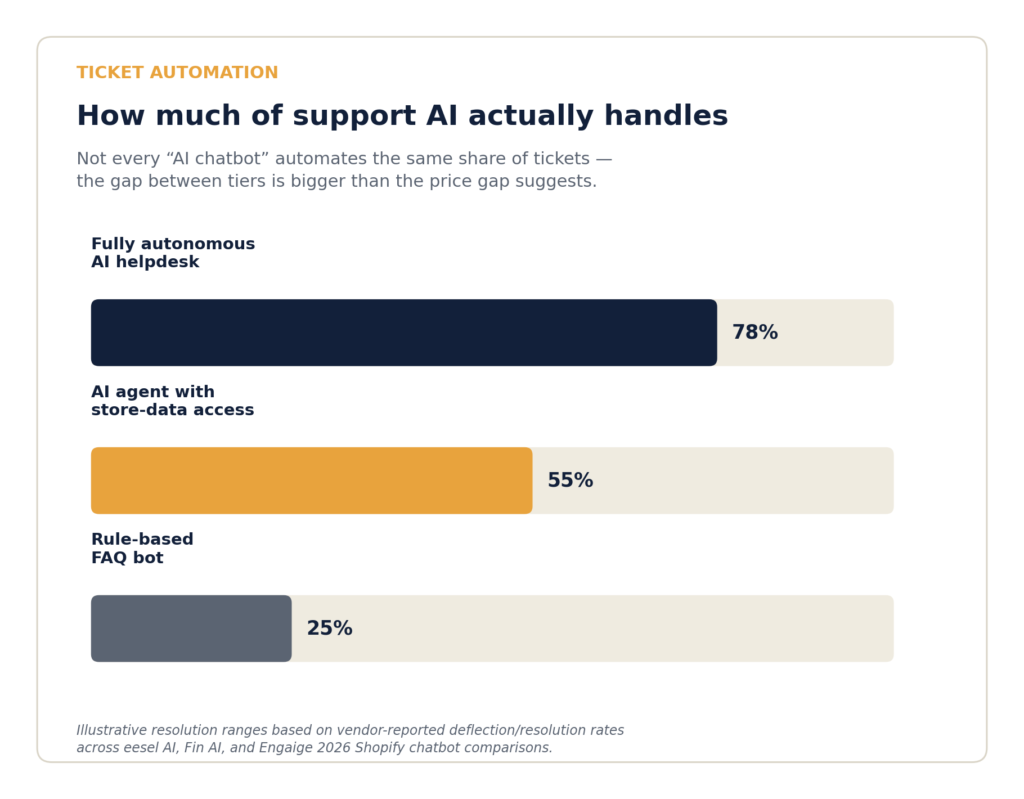
How Much of Support AI Actually Handles
Not every “AI chatbot” automates the same share of your support volume. Basic rule-based bots mostly deflect simple FAQ questions; true AI agents with store-data access resolve meaningfully more, and fully autonomous helpdesks resolve the most — at the highest cost. Chatbots and email marketing tools increasingly overlap as both add AI-driven personalization.
Editor’s Note
Don’t compare price alone. A cheaper tool that only deflects 20–30% of tickets may cost you more in remaining manual work than a pricier one resolving 70%+.
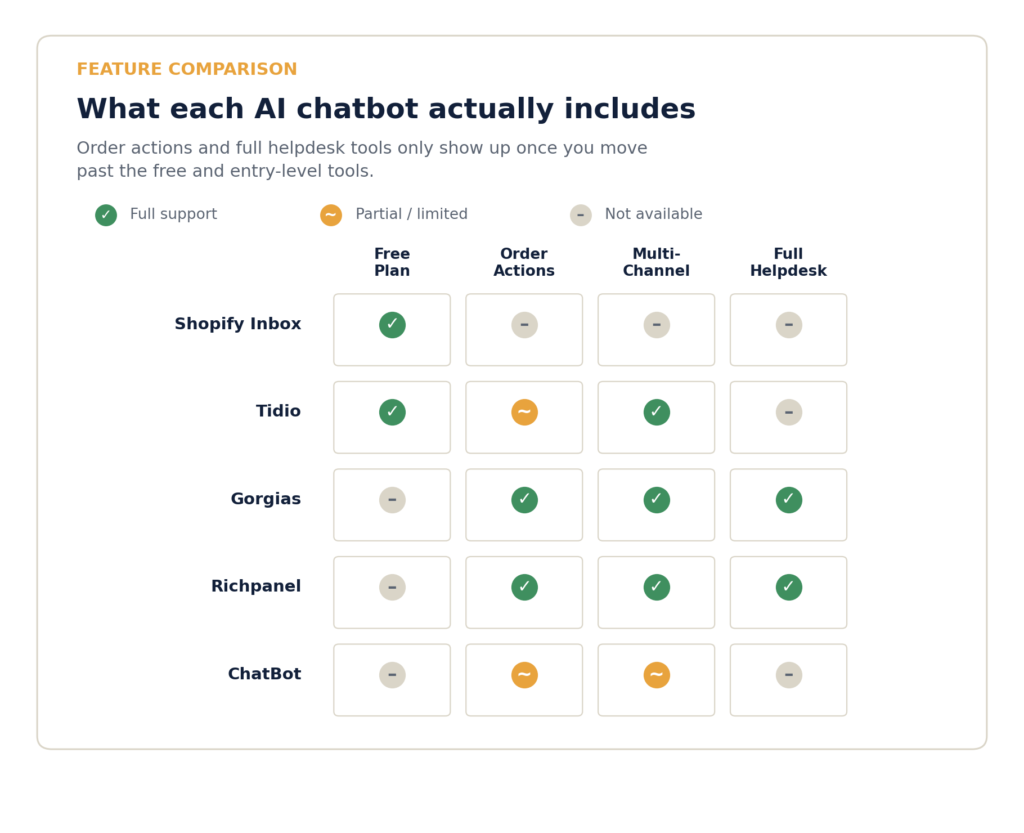
Feature Comparison
Frequently Asked Questions About Best AI Chatbots for Shopify
Do I Need a Chatbot If I Already Have Shopify Inbox?
If your store handles fewer than roughly 200 conversations a month and your team keeps up comfortably, no. Once repeat “where is my order” and return questions start piling up, a dedicated AI chatbot with real deflection capability typically pays for itself in time saved.
What’s the Cheapest AI Chatbot for Shopify?
Shopify Inbox is free but has limited AI capability. Among dedicated AI tools, Tidio’s Lyro AI offers the lowest-cost real AI add-on, starting around $32.50/month for 50 AI conversations.
Can AI Chatbots Process Refunds and Cancel Orders on Shopify?
Some can. More advanced AI agents (like Gorgias and Richpanel) can take real actions inside Shopify — processing refunds, editing shipping addresses, canceling orders — while simpler chatbots are typically limited to answering questions and routing customers to a human for anything requiring an account action.
How Much Does an AI Chatbot Cost for a Small Shopify Store?
Entry-level AI chatbot plans typically run $32–$50/month for small stores, scaling up to $300–500/month for fully autonomous, high-volume helpdesk tools. Many tools also charge per-conversation or per-resolution fees on top of a base subscription once you exceed included volume.
Bottom Line: Choosing an AI Chatbot for Your Store
Bottom Line
Start with Shopify Inbox if your support volume is still low — there’s no reason to pay before you need to. Move to Tidio once repeat questions start costing you real time, and consider Gorgias or Richpanel only once your ticket volume genuinely justifies a fuller (and pricier) automation setup. The right tool matches your current support volume, not where you hope to be in a year.
Using a chatbot that isn’t on this list? Reach out at contact@ecomfundingguide.com — we’re always comparing real seller setups.
How We Evaluated These Picks
We compare current, publicly listed pricing directly from each provider’s official site, and weigh the following when ranking picks: