This post contains affiliate links. If you sign up for a product through one of these links, we may earn a commission at no extra cost to you. See our Affiliate Disclosure for details.
Spreadsheet-based inventory forecasting works fine until you cross roughly 50 SKUs or add a second sales channel — after that, static reorder rules start costing real money in stockouts and overstock. Below are five AI inventory forecasting tools worth trying in 2026, based on current pricing and what each one is actually built for.
Key Takeaways
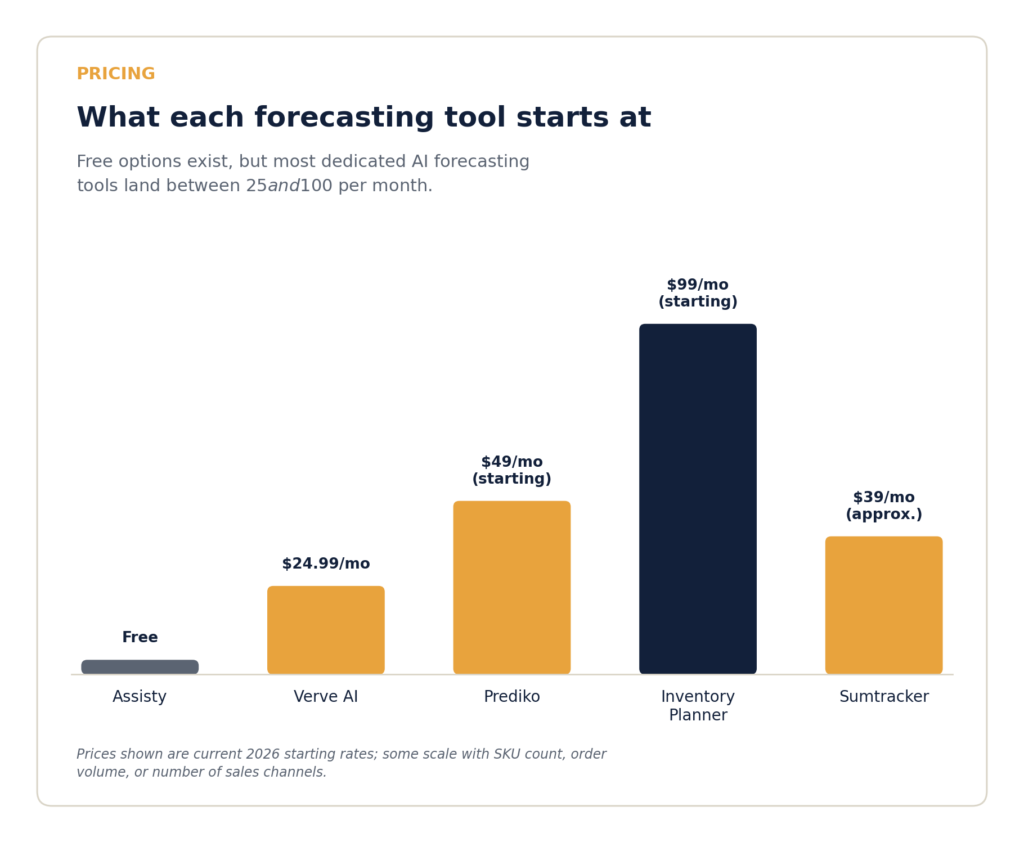
- Best for Shopify-first brands: Prediko forecasts demand and auto-generates purchase orders directly from your Shopify data, starting at $49/month.
- Best overall value: Verve AI combines solid accuracy with the lowest price of the paid tools here, starting at $24.99/month with no developer needed to set up.
- Best for 3+ sales channels: Inventory Planner is the most mature option once you’re managing forecasts across multiple channels, starting at $99/month.
- Best free option: Assisty offers genuine forecasting functionality at no cost, a reasonable starting point before committing to a paid tool.
- The real payoff is measurable: independent 2026 testing across live Shopify stores found AI forecasting reduced stockouts by 30-50% and cut overstock by 20-35% compared to manual methods.
Jump to a pick
AI Inventory Forecasting Tools: The Short Answer
For Shopify-first brands with clean historical sales data, Prediko is the strongest dedicated option, particularly if you want forecasts turned automatically into purchase orders. Verve AI offers the best balance of price and accuracy for small Shopify or WooCommerce stores not yet ready for Prediko’s price point. Inventory Planner is worth the higher cost once you’re managing three or more sales channels. Assisty is a legitimate free starting point if you want to try AI forecasting before paying for it.
Feature Comparison
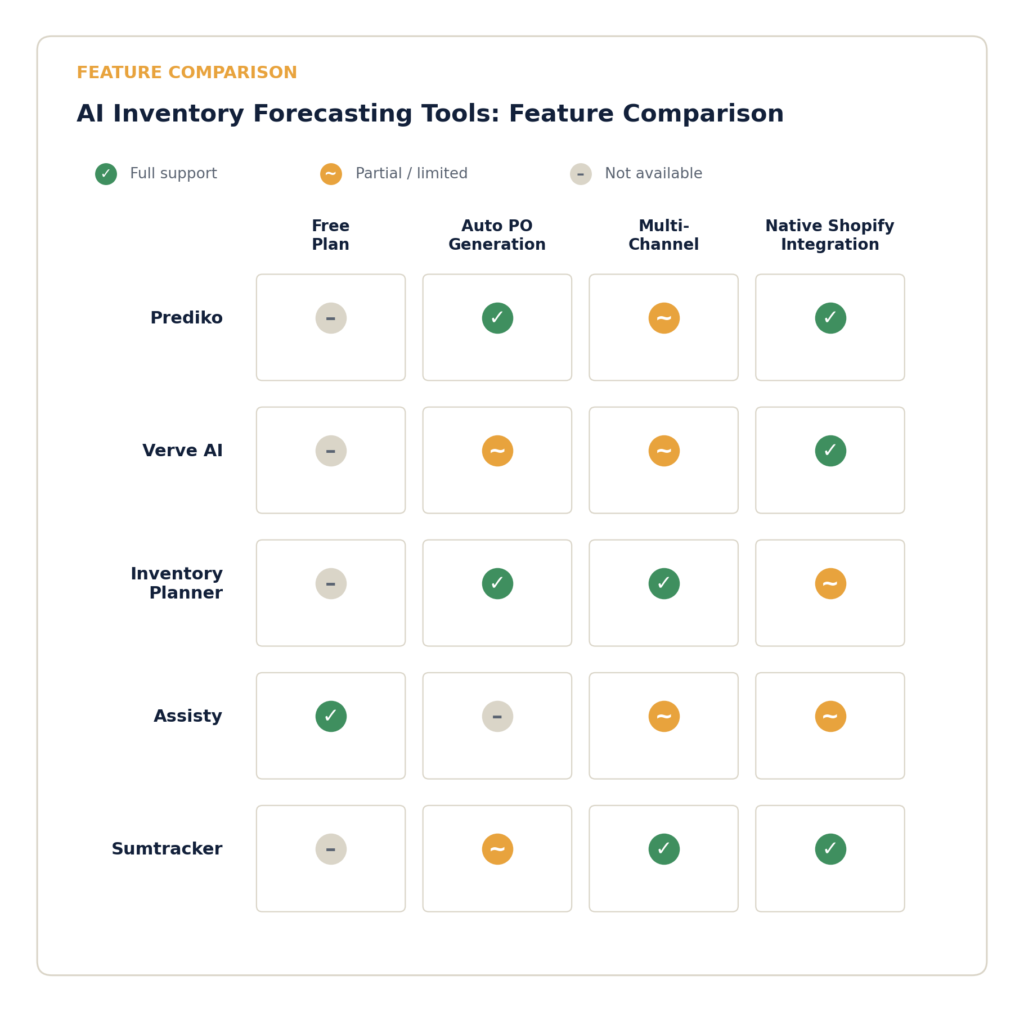
Prediko and Sumtracker lead on native e-commerce integrations; Assisty trades features for a genuinely free plan.
The 5 Tools
Prediko: Best for Shopify-First Brands
Prediko forecasts demand for seasonal and steady-selling products based on historical trends, then auto-generates purchase order recommendations with suggested quantities and timing — you can review and send POs directly to suppliers from within the platform. Pricing starts at $49/month, scaling with SKU count and location count. The tradeoff: it requires 12+ months of sales history to forecast well, and it’s built specifically for e-commerce rather than wholesale or B2B inventory.
Best for: Shopify-first brands with at least a year of clean sales data who want forecasts turned directly into actionable purchase orders.
Verve AI: Best Overall Value
Verve AI is built specifically for Shopify and WooCommerce merchants, with variant-level forecasting and a setup process that doesn’t require a developer. At $24.99/month, it’s the least expensive paid, dedicated forecasting tool in this comparison, making it a practical next step once you’ve outgrown free tools.
Best for: Small Shopify or WooCommerce stores wanting real AI forecasting without Prediko’s or Inventory Planner’s price point.
Inventory Planner: Best for Multichannel Sellers
Inventory Planner is a mature, pure-play forecasting and replenishment tool that integrates with most e-commerce and ERP platforms, with a consolidated view across channels that becomes genuinely useful once you’re selling in three or more places. Pricing starts at $99/month. Setup takes more effort than the Shopify-only tools here, which is the tradeoff for its broader channel support.
Best for: Sellers managing inventory across three or more active sales channels.
Assisty: Best Free Option
Assisty offers legitimate AI-assisted forecasting at no cost, a genuine option for sellers not ready to commit to a paid tool. As with most free tiers, expect fewer advanced features (automated PO generation, multi-location planning) than the paid options here — treat it as a way to test whether AI forecasting is worth paying for, not a permanent solution for a growing catalog.
Best for: Sellers wanting to try AI forecasting before paying for a dedicated tool.
Sumtracker: Best for Cross-Channel Sync
Sumtracker tracks real sales velocity, current stock levels, and supplier lead times to guide reorder decisions, keeping inventory data synced across Shopify, Amazon, Etsy, and other channels so forecasts reflect actual demand rather than channel-siloed guesses.
Best for: Sellers who specifically need reorder recommendations synced tightly across several storefronts.
Pricing at a Glance
Does AI Forecasting Actually Move the Needle?
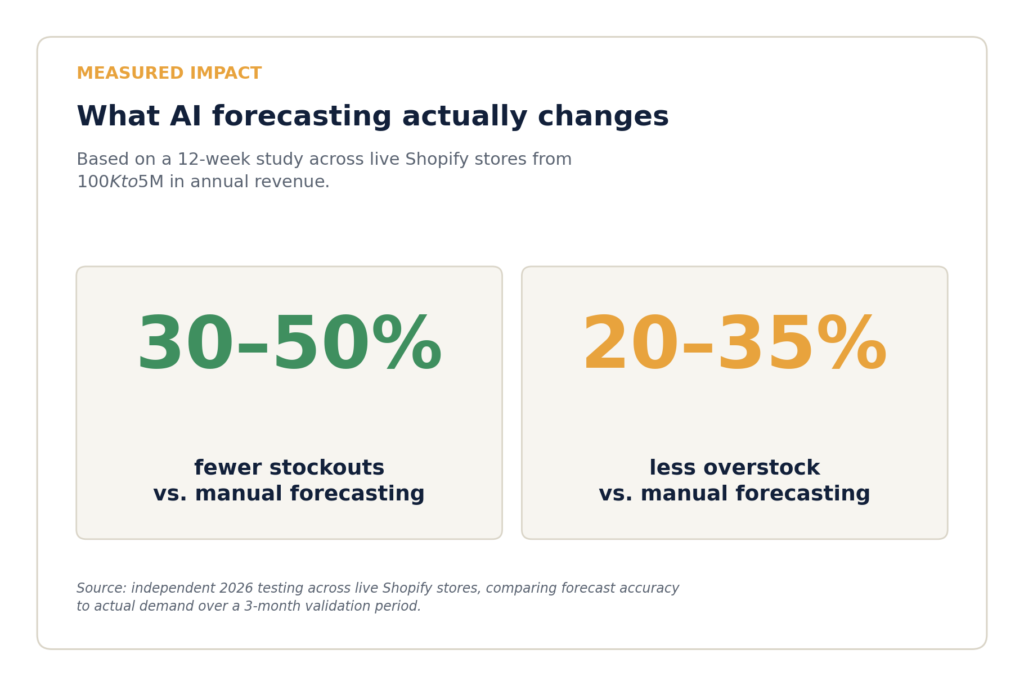
A 12-week study across live Shopify stores found meaningful, measurable reductions in both stockouts and overstock.
The Measured Impact
Independent 2026 testing across live Shopify stores ranging from $100K to $5M in annual revenue found AI forecasting tools reduced stockouts by 30-50% and cut overstock by 20-35% compared to manual, spreadsheet-based methods. This is a meaningful, measurable improvement — not just a nicer dashboard — which is worth keeping in mind when weighing a $25-100/month tool against the cost of either lost sales from stockouts or cash tied up in dead stock.
How to Choose the Right Tool
A single-channel Shopify store with a large catalog has simpler forecasting needs than a smaller multichannel store, since consolidating demand signals across channels is the harder technical problem. Choose based on how many places you sell, not just how many SKUs you carry.
Most AI forecasting tools need 12+ months of sales data to forecast well. A newer store without that history will get less value from these tools initially — spend that first year building clean sales data before expecting a forecasting tool to outperform manual planning.
Frequently Asked Questions About AI Inventory Forecasting
What Is the Best Free AI Inventory Forecasting Tool?
Assisty offers genuine AI-assisted forecasting at no cost, making it a reasonable way to test whether the category is worth paying for. Most free tools offer fewer advanced features than paid options like Prediko or Inventory Planner.
How Much Does AI Inventory Forecasting Cost for a Small Store?
Shopify and WooCommerce merchants can expect to pay $25-100/month for a capable AI forecasting tool, with enterprise platforms starting at several thousand dollars per month plus implementation costs.
Does AI Inventory Forecasting Actually Reduce Stockouts?
Independent 2026 testing across live Shopify stores found AI forecasting reduced stockouts by 30-50% and cut overstock by 20-35% compared to manual methods, based on a 3-month validation period comparing forecast accuracy to actual demand.
How Much Sales History Do I Need for AI Forecasting to Work Well?
Most tools recommend at least 12 months of historical sales data to forecast accurately, since this captures a full seasonal cycle. Stores with less history can still use these tools, but forecast accuracy is typically lower until a full year of data is available.
Bottom Line: Choosing an AI Inventory Forecasting Tool
Bottom Line
Start with Assisty if you want to test the category for free, or Verve AI if you’re ready for a dedicated paid tool without a big commitment. Move to Prediko once purchase-order automation matters, or Inventory Planner once you’re managing three or more sales channels. Whichever you choose, make sure you have at least a year of clean sales history before expecting a meaningful accuracy improvement over manual forecasting.
Using a forecasting tool that isn’t on this list? Reach out at contact@ecomfundingguide.com — we’re always comparing real seller setups.
How We Evaluated These Picks
We compare current, publicly listed pricing and features directly from each provider’s official site, and weigh the following when ranking picks: