
This post contains affiliate links. If you sign up for a product through one of these links, we may earn a commission at no extra cost to you. See our Affiliate Disclosure for details.
Klaviyo and Mailchimp are the two most-searched email platforms among e-commerce brands in 2026, and for good reason — both are polished, both have massive user bases, and both get recommended constantly. But they’re built for genuinely different users, and picking based on brand recognition alone is how stores end up outgrowing their platform (or overpaying for depth they never use). Below is a real, current comparison of Klaviyo vs. Mailchimp: which is better for online stores.
Key Takeaways
- Best for e-commerce depth: Klaviyo’s native Shopify integration, browse abandonment triggers, and predictive analytics give it a real structural advantage for stores that rely on email as a revenue channel.
- Best for ease and price at small scale: Mailchimp is simpler to learn and generally cheaper under roughly 2,500 contacts, making it a reasonable starting point for very early-stage stores.
- The inflection point is real: most comparisons put the crossover around $250K/year in revenue or 2,500 contacts — below that, Mailchimp often suffices; above it, Klaviyo’s automation depth tends to pay for its higher price.
- Deliverability is close to a tie: both platforms land in a similar 92-96% inbox placement range for properly authenticated senders; this isn’t a deciding factor either way.
- Watch how each platform bills: Klaviyo charges only for “active” profiles; Mailchimp bills for all contacts in your audience, including unsubscribed ones — this changes the real-world cost comparison more than the sticker price suggests.
Jump to a section
Klaviyo vs. Mailchimp: The Short Answer
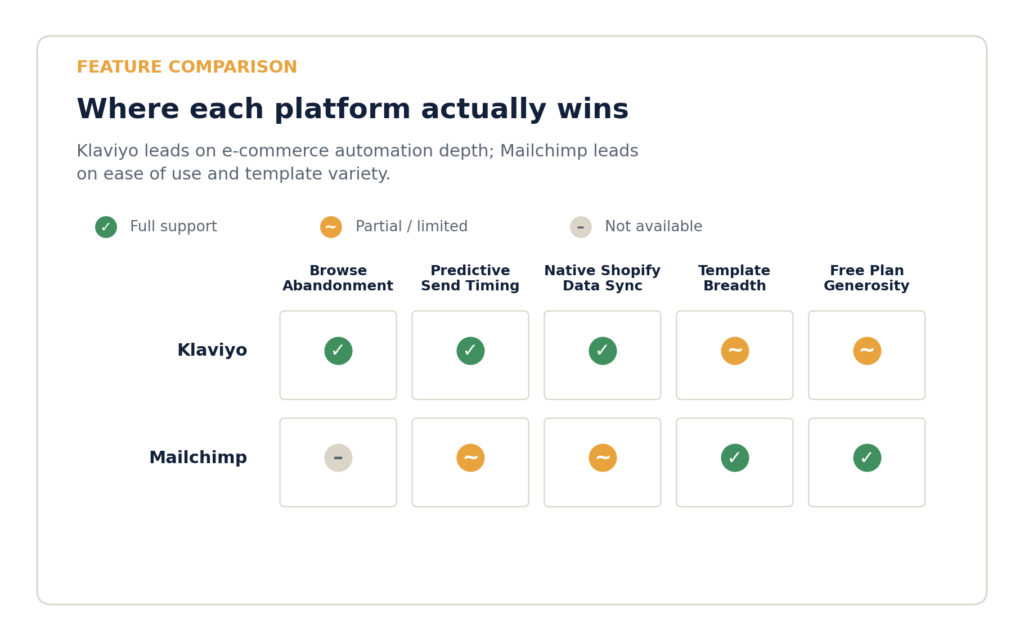
For stores that treat email as a real revenue channel — not just a newsletter — Klaviyo is the stronger choice. Its e-commerce-native data model (orders, products, browsing behavior) enables automation Mailchimp simply doesn’t offer, like browse abandonment and predictive send timing. Mailchimp remains the better fit for very early-stage stores, non-e-commerce use cases, or anyone prioritizing ease of use and template variety over deep automation. If you’re already covering the basics with Shopify Email or another entry-level tool, the decision between Klaviyo and Mailchimp usually comes down to whether your store has outgrown simple broadcast campaigns.
Feature Comparison: Where Each Platform Actually Wins
Automation and Segmentation
This is where the gap is largest. Klaviyo triggers flows off real store events — abandoned cart, browse abandonment (viewing a product without adding to cart), post-purchase, and win-back sequences — all built on real-time behavioral data synced directly from Shopify. Mailchimp’s Customer Journey Builder (available on its Standard plan) supports multi-step automation too, but notably lacks native browse abandonment at any tier, a trigger that commonly drives 5-15% of total email revenue for stores that have it.
Predictive Analytics and AI
Klaviyo’s predictive tools estimate a customer’s likely next purchase date and lifetime value, letting you time replenishment emails around actual purchase probability rather than a fixed schedule. Mailchimp offers CLV-based insights and predictive demographics as well, but they’re used mainly for segmentation and reporting rather than driving deeply automated, behavior-triggered flows.
Deliverability
Independent testing in 2026 places both platforms in a similar 92-96% inbox placement range for authenticated senders — this is close enough to a tie that it shouldn’t drive your decision. Klaviyo’s Smart Sending feature (which suppresses emails to recently-messaged contacts) offers a modest edge for engagement management, but the underlying sending infrastructure is solid on both sides.
Ease of Use and Templates
Mailchimp wins clearly here. Its interface and template library are built for approachability, and non-technical users tend to get a functional campaign running faster. Klaviyo’s builder is more powerful once you’re using its e-commerce data blocks (dynamic product feeds, pricing, personalized sections), but that power comes with a steeper learning curve.
Pricing: What You’ll Actually Pay
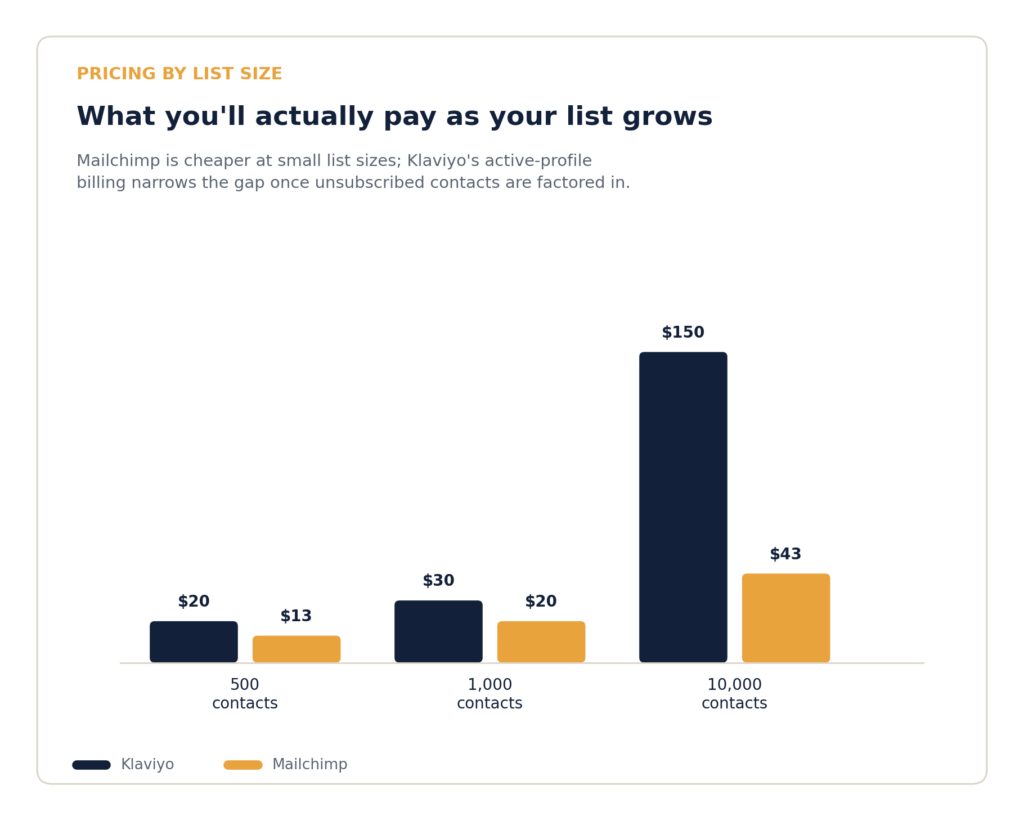
Klaviyo’s free plan covers up to 250 active profiles and 500 monthly sends. Paid pricing then scales with your active profile count: roughly $20/month at 500 profiles, $30 at 1,000, $100-150 at 5,000-10,000, and up to $2,300/month at 250,000 profiles. SMS is billed separately through its own credit system.
Mailchimp starts around $13/month, with its Standard plan (which unlocks Customer Journey Builder automation) beginning around $20/month and reaching roughly $43/month at 10,000 contacts.
The Number That Matters More Than the Sticker Price
Klaviyo bills only “active” profiles — people who can actually be emailed, excluding unsubscribed or suppressed contacts. Mailchimp bills for your full audience, including unsubscribed contacts, unless you actively archive them. A store with a large, stale list can end up paying Mailchimp for contacts that no longer generate any value, which narrows the apparent price gap considerably at real-world scale.
When Each Platform Makes Sense
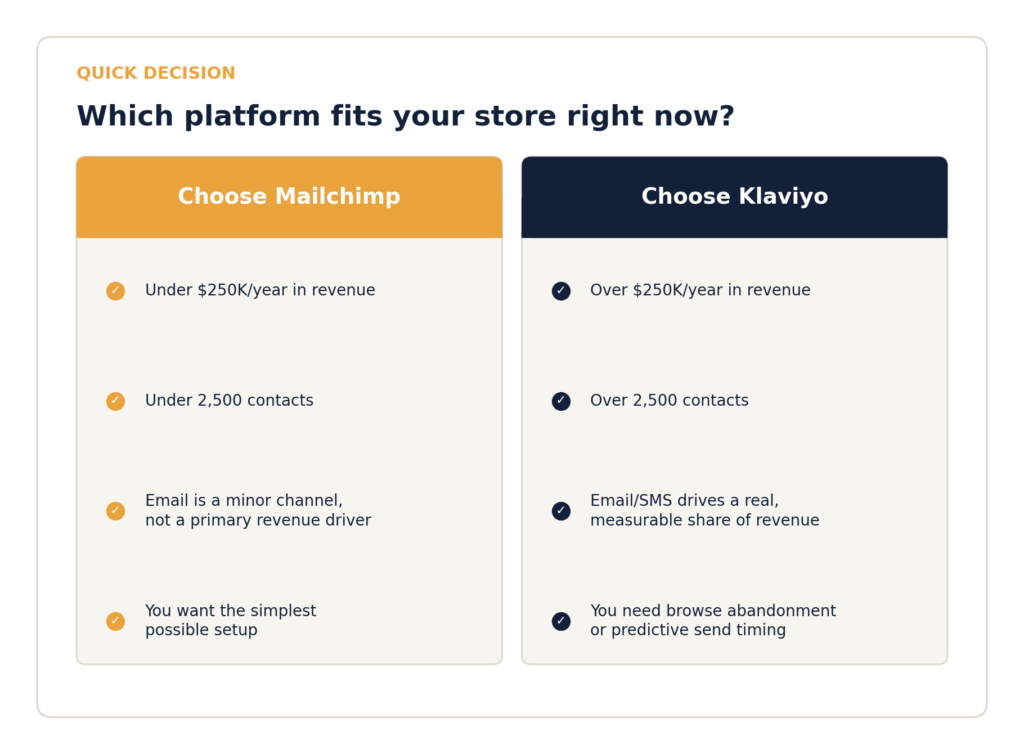
The decision usually comes down to two numbers: your annual revenue and your contact count.
You’re under $250K/year or 2,500 contacts. At this stage, Klaviyo’s deeper automation often costs more than it returns, since you likely don’t have the order volume yet for browse abandonment or predictive send timing to meaningfully move revenue. Mailchimp’s lower cost and simpler setup make more sense here.
Email is becoming a real revenue channel for your store. Klaviyo’s own 2026 benchmark data (drawn from 183,000+ accounts) shows automated flows generate nearly 41% of total email revenue from just 5.3% of sends — an 18x higher revenue-per-recipient than one-off campaigns. This is a vendor-reported figure, not independently audited, but it illustrates why the automation depth tends to translate into real revenue.
Frequently Asked Questions About Klaviyo vs. Mailchimp
Is Klaviyo Worth the Higher Price Over Mailchimp?
For stores above roughly $250K/year in revenue, most comparisons find yes — the additional automation (browse abandonment, predictive analytics, deeper segmentation) tends to generate enough incremental revenue to outweigh the price difference. Below that threshold, Mailchimp’s lower cost is often the better fit.
Does Mailchimp Have Abandoned Cart Emails Like Klaviyo?
Mailchimp supports basic abandoned cart automation through its Customer Journey Builder, but it lacks Klaviyo’s browse abandonment trigger (which fires when someone views a product without adding to cart) at any pricing tier.
Can I Migrate from Mailchimp to Klaviyo Without Losing Data?
Contacts and basic profile data typically migrate cleanly, but automated flows generally need to be rebuilt rather than imported, since Klaviyo’s e-commerce data model works differently from Mailchimp’s. Most migration guides recommend running both platforms in parallel for a couple weeks to confirm new flows are working before fully canceling the old one.
Which Platform Has Better Deliverability, Klaviyo or Mailchimp?
They’re close enough to call it a tie. Independent 2026 testing places both in a similar 92-96% inbox placement range for properly authenticated senders — deliverability shouldn’t be the deciding factor between them.
Bottom Line: Klaviyo or Mailchimp for Your Store
Bottom Line
If email is still a minor channel for your store, or you’re under roughly $250K/year in revenue, Mailchimp’s lower cost and simpler setup are the more sensible choice. Once email becomes a real revenue driver — meaningful order volume, an engaged list, and automation actually worth building — Klaviyo’s e-commerce-native depth is built specifically for that stage, and its pricing tends to make more sense once you’re there. Neither platform is the wrong choice in the abstract; the right one depends entirely on which stage your store is actually in.
Once your email stack is sorted, AI chatbots are often the next customer-experience tool worth adding.
Switched between these two and have real numbers to share? Reach out at contact@ecomfundingguide.com — we’re always updating this comparison with real seller data.
How We Researched This Comparison
We pulled current 2026 pricing directly from Klaviyo’s and Mailchimp’s own pricing pages, plus independent 2026 deliverability testing, and weighed the following: