
This post contains affiliate links. If you sign up for a product through one of these links, we may earn a commission at no extra cost to you. See our Affiliate Disclosure for details.
If you’re comparing Shopify Capital vs. Clearco, the honest starting point is that neither one gives you a public rate card — both price funding individually, based on your store’s actual sales and risk profile. What you can compare ahead of time is how each product is structured, who’s eligible, and what the real cost tends to look like once a factor rate or flat fee gets converted into something comparable to an interest rate. This guide walks through both, using current 2026 terms sourced directly from Shopify and independent reviews of Clearco.
Key Takeaways
- Shopify Capital is Shopify-exclusive: you must be a Shopify merchant using Shopify Payments, and funding is offered by invitation — there’s no open application.
- Clearco works across platforms: it evaluates Shopify, Amazon, and ad account data directly, making it available to sellers Shopify Capital wouldn’t reach.
- Both price as a flat fee, not a stated APR: Shopify Capital’s factor rate typically runs 1.10–1.17 (roughly a 10–17% fee); Clearco’s cash advance fee is commonly cited in the 6–12.5% range, though sources vary.
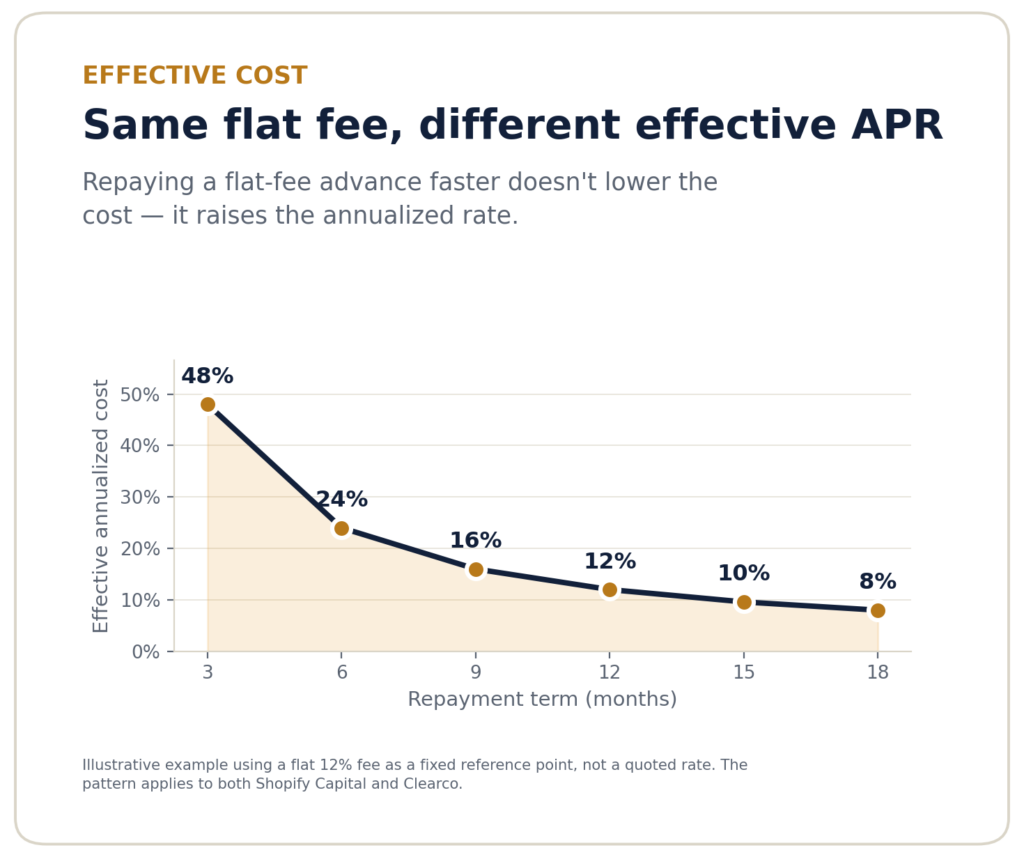
- Speed of repayment changes your real cost a lot: because the fee is fixed regardless of how fast you repay, paying back quickly can push the effective APR surprisingly high — both providers work this way.
- Neither number is guaranteed: your actual offer depends on your specific sales history and risk profile. Treat every figure below as a range to sanity-check your own offer against, not a quote.
Jump to a section
Short Answer: Shopify Capital vs. Clearco
If you’re an established Shopify store using Shopify Payments, Shopify Capital is usually the simpler option — there’s no application, and offers are calculated directly from your store’s own sales data. If you sell across multiple platforms, run significant ad spend, or haven’t received a Shopify Capital offer, Clearco is worth evaluating instead, since it underwrites based on your actual revenue and ad performance rather than requiring you to already be inside Shopify’s ecosystem. Neither is automatically cheaper — you need your specific offer numbers from both to know for sure.
Both are just two of several financing paths — see our complete guide to e-commerce financing options for the full picture.
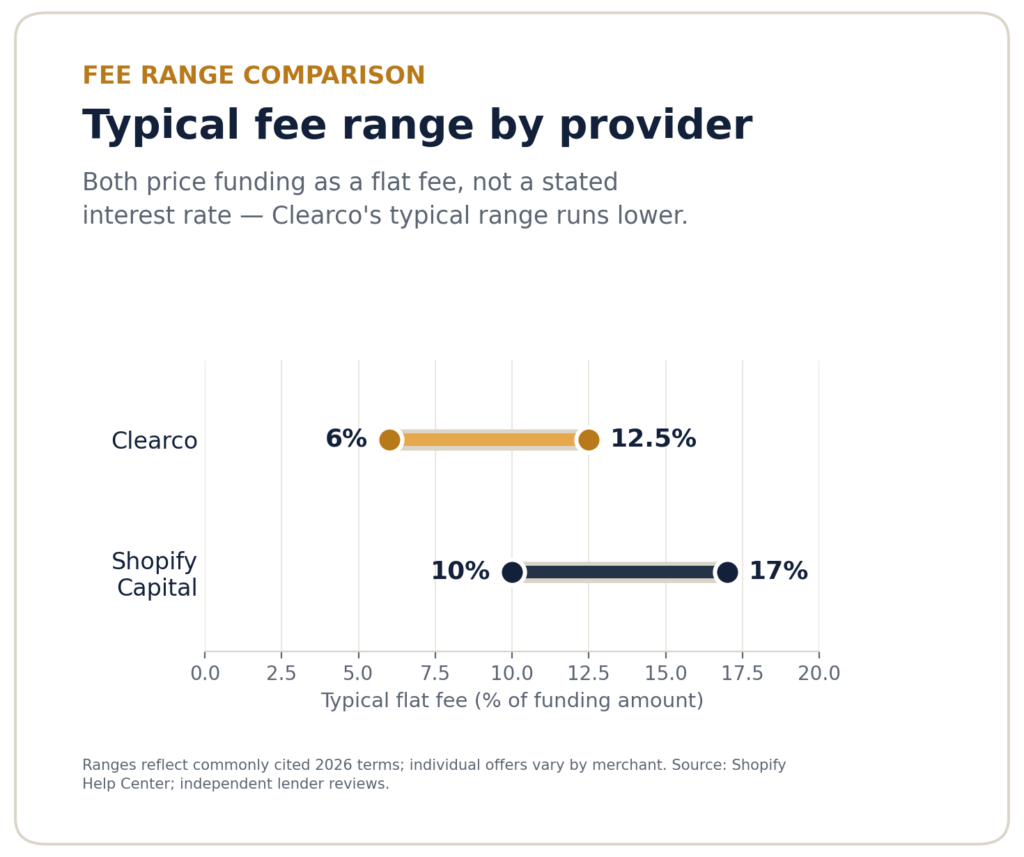
Rates and terms are individualized per merchant and change over time — confirm current numbers directly with each provider before applying. Source: Shopify Help Center.
Shopify Capital: How It Works
Shopify Capital is built directly into your Shopify admin. There’s no separate application — if your store qualifies, an offer simply appears in the Capital section under Finances, calculated from your store’s sales history, order volume, and payment processing data.
Shopify requires Shopify Payments as your payout method (it’s how they underwrite the offer), and most merchants need at least a few months of steady sales history before receiving one. You can choose between a fixed-fee or monthly-fee repayment plan, and repayment happens automatically as a percentage of daily sales — typically 10–17% — with no payment at all on a zero-sales day. The total must be repaid within an 18-month maximum term, with minimum repayment milestones (roughly 30% by month 6, 60% by month 12) that apply regardless of how slow sales get.
Best for: Shopify-native merchants who want the simplest possible path to funding, with zero separate application.
Clearco: How It Works
Clearco (formerly Clearbanc) evaluates funding based on your store and marketing performance rather than requiring you to be on any specific platform, which is the core structural difference from Shopify Capital.
You connect your store (Shopify, Amazon, or others) and ad accounts (Google, Meta, TikTok), and Clearco’s underwriting evaluates revenue, ad spend efficiency, and growth trajectory to generate an offer, typically within hours. Clearco offers a few distinct products: a revenue-share cash advance, and a separate Invoice Funding product with published, fixed weekly-payment tiers (5% at a 4-month term, 6.25% at 5 months, 8% at 6 months). The broader cash-advance product doesn’t publish a clean rate table — expect a flat fee commonly cited in the 6–12.5% range, with the specific number depending on your revenue consistency and risk profile.
Best for: Sellers who run meaningful ad spend, sell on multiple platforms, or haven’t received a Shopify Capital offer.
Fees and Real Cost, Compared
Both providers price funding as a flat fee rather than a stated interest rate, which makes them hard to compare against a traditional loan — or against each other — without doing a little math. Neither is automatically cheaper — and what you’re funding matters too, whether that’s inventory or ad spend.
The Counterintuitive Part
With both Shopify Capital and Clearco, the total fee is fixed the moment you accept the offer — paying it back faster doesn’t save you money, it just concentrates the same fee into a shorter window, which raises your effective APR. A $10,000 advance at a 1.15 factor rate costs $1,500 no matter what. Repaid in 3 months, that’s an effective APR north of 50%; repaid over 12 months, it’s a much more modest annualized rate. Independent analysis of both products puts the realistic effective APR range anywhere from roughly 12% to 60%+ depending entirely on repayment speed. Before accepting either offer, estimate how fast your actual sales pace will repay it, and convert the flat fee to an annualized rate for a fair comparison against a bank loan or line of credit.
Eligibility Requirements
The eligibility bar is structured differently for each, which often decides the question before cost even enters the picture.
Shopify Capital Eligibility
Active Shopify store using Shopify Payments (or an approved third-party provider), generally at least 3 months of operating history, and consistent sales with reasonably low chargeback/refund rates. There’s no credit check or application — Shopify’s own algorithm decides who receives an offer, and not every merchant will.
Clearco Eligibility
An active e-commerce or DTC business with connectable sales and/or ad account data, basic incorporation documents, and a bank account for underwriting. Clearco is open to a formal application rather than an invite-only model, but funding decisions still depend heavily on consistent revenue and ad performance.
Which Option Fits Your Situation
Choose Shopify Capital If
You’re Shopify-native, already use Shopify Payments, and you’d rather not go through a separate application at all — you’re just waiting to see if an offer appears.
Choose Clearco If
You sell across multiple platforms, run significant ad spend you can point to as growth evidence, or you haven’t received a Shopify Capital offer and need another door to knock on.
Frequently Asked Questions
Is Shopify Capital or Clearco Cheaper?
Neither is reliably cheaper in the abstract — both price fees individually per merchant, with cited ranges of roughly 10–17% for Shopify Capital and 6–12.5% for Clearco’s cash advance product. The only way to know which is cheaper for your business is to compare your actual offers side by side, converted to an effective APR based on your expected repayment speed.
Can I Use Both Shopify Capital and Clearco at the Same Time?
It’s possible in principle since they’re separate providers, but stacking revenue-based financing from two sources means two simultaneous daily sales sweeps, which can meaningfully strain cash flow. Most advisors recommend fully evaluating whether you need both before taking on two concurrent advances.
What Happens If My Sales Slow Down and I Can’t Meet Repayment Milestones?
For Shopify Capital specifically, missing minimum repayment milestones (roughly 30% by 6 months, 60% by 12 months) can put your loan in default, and Shopify may require a manual payment to catch up. This is one of the more important risks to plan around before accepting a large advance ahead of a historically slow season.
Does Either Option Require a Personal Guarantee or Equity?
No — both are structured as non-dilutive, revenue-based financing rather than equity investment, and neither typically requires a personal guarantee in the way a traditional bank loan or SBA loan does. This is one of the main reasons both products are popular with founders who want to avoid giving up equity or personal collateral.
Bottom Line: Choosing Between Shopify Capital and Clearco
Bottom Line
If you’re a Shopify-native store using Shopify Payments, check whether you already have a Shopify Capital offer waiting in your admin — it’s the lowest-friction option available, with no separate application. If you sell across multiple channels, run meaningful ad spend, or Shopify hasn’t extended you an offer, Clearco is a legitimate second door, particularly for its published Invoice Funding tiers if that product fits your need.
Whichever you’re considering, get your actual offer numbers from both before deciding, convert the flat fee to an effective APR based on your realistic repayment timeline, and — given how much a wrong call here can cost — consider running the numbers past an accountant (the right accounting stack can help track repayments against daily settlements automatically) or financial advisor before signing anything.
Used Shopify Capital or Clearco and have real numbers to share, or a question this guide didn’t cover? Email us at contact@ecomfundingguide.com — we read every message.
This article is for informational purposes and isn’t financial advice. Rates, fees, and eligibility criteria for both products change over time and are individualized per merchant — confirm current terms directly with Shopify and Clearco, and consider consulting a financial professional before accepting any funding offer.
How We Researched This Comparison
We sourced Shopify Capital’s terms directly from Shopify’s official Help Center, and cross-referenced multiple independent 2026 reviews for Clearco’s fee structure since it doesn’t publish one consolidated public rate table. We weighed:
This article is for informational purposes and isn’t financial advice. Rates, fees, and eligibility criteria for both products change over time and are individualized per merchant — confirm current terms directly with Shopify and Clearco, and consider consulting a financial professional before accepting any funding offer.