This post contains affiliate links. If you sign up for a product through one of these links, we may earn a commission at no extra cost to you. See our Affiliate Disclosure for details.
There’s no single best e-commerce platform for small business — there’s a best one for your specific budget, technical comfort, and catalog size. This guide compares the five platforms small business owners actually choose between in 2026, with real current pricing and a clear sense of who each one is genuinely built for, rather than a generic “it depends” shrug.
Key Takeaways
- Shopify remains the fastest path to launch with the least technical setup, at the cost of a monthly platform fee that WooCommerce doesn’t have.
- WooCommerce is free software, but “free” doesn’t mean $0 — hosting, a domain, and your own time managing updates are real costs.
- Wix and Squarespace both now offer genuinely capable e-commerce tiers, not just simple website builders with a checkout bolted on.
- BigCommerce’s native multichannel selling (Amazon, eBay, social) can reduce how many paid apps you need compared to Shopify.
- Transaction fees vary meaningfully by platform and plan tier — a lower monthly price can end up costing more once you factor in per-sale fees.
Jump to a platform
Short Answer: Best E-Commerce Platform for Small Business
For most small businesses, Shopify remains the best all-around starting point — the fastest setup, the largest app ecosystem, and no separate hosting to manage. If long-term cost matters more than setup speed and you’re comfortable with (or willing to learn) WordPress, WooCommerce is genuinely cheaper over time. Wix and Squarespace are strong picks if you want built-in design flexibility without a steep learning curve, and BigCommerce is worth a look specifically if multichannel selling (Amazon, eBay, social) matters to you from day one. For the full picture on getting your store funded and set up beyond just the platform decision, see our complete guide to starting an online store.
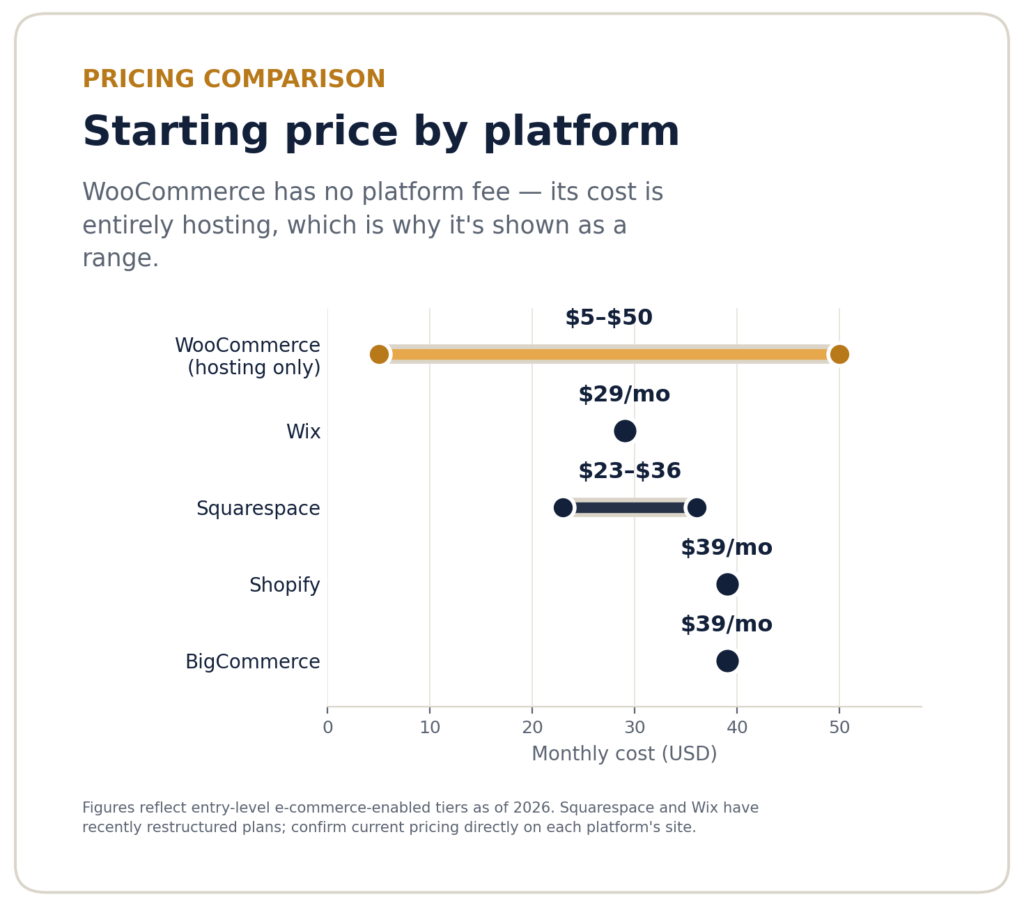
WooCommerce has no platform fee — its cost is entirely hosting, which is why it’s shown as a range.
The Best E-Commerce Platforms for Small Business
Shopify
Shopify bundles hosting, security, and PCI compliance into one flat monthly fee, which is why it remains the default starting point for most new sellers. Its Basic plan runs around $39/month, with pricing scaling up through Grow and Advanced tiers as you need more staff accounts, lower payment processing rates, and advanced reporting. Shopify’s app ecosystem is the largest of any platform here, which matters once you outgrow the built-in feature set. If you’re specifically weighing Shopify against a self-hosted alternative, our Shopify vs. WooCommerce cost comparison breaks down the real numbers.
Best for: Sellers who want the fastest path to a live store with the least technical setup.
WooCommerce
WooCommerce itself is a free WordPress plugin — there’s no license fee and no revenue cut. Your actual costs are hosting (typically $5–50/month) and a domain, which puts a lean first year in the realistic $100–300 range. The tradeoff is real: you’re responsible for your own hosting reliability, security updates, and plugin compatibility, which costs either time or money to manage properly. See our full Shopify vs. WooCommerce breakdown for exactly how the year-one costs compare.
Best for: Sellers comfortable with WordPress who want lower long-term costs and more backend control.
BigCommerce
BigCommerce’s entry-tier pricing sits close to Shopify’s, but it bundles more multichannel selling — Amazon, eBay, and social selling — natively into lower tiers, which can mean fewer paid apps to reach the same functionality. It also doesn’t force plan upgrades based on revenue the way it once did more aggressively, though it’s still tied to sales thresholds at higher tiers. If you’re weighing it directly against Shopify, our Shopify vs. BigCommerce comparison covers the 2026 pricing changes in detail.
Best for: Sellers who want multichannel selling built in without stacking third-party apps to get there.
Wix
Wix restructured its plans in 2025 into four simplified tiers, with the Core plan (around $29/month on annual billing) as the entry point for e-commerce — product listings and checkout aren’t available on the free or Light tiers. Wix charges no platform transaction fees on its e-commerce plans, which is a genuine advantage over platforms that add a percentage on top of payment processing. Design flexibility is a real strength here, closer to a website builder than a dedicated commerce platform.
Best for: Sellers who want strong design control and no platform transaction fees, without Shopify’s steeper learning curve.
Squarespace
Squarespace’s e-commerce-enabled plans commonly run somewhere in the $23–36/month range depending on tier (exact plan names and prices have shifted recently, so confirm current figures directly on their site), with transaction fees applying on lower tiers and dropping to 0% on higher ones. Squarespace edges out Wix on design polish for content-heavy stores, but has a smaller app marketplace, meaning less flexibility once you need a specific integration.
Best for: Design-focused sellers, especially those pairing a store with strong editorial or portfolio content.
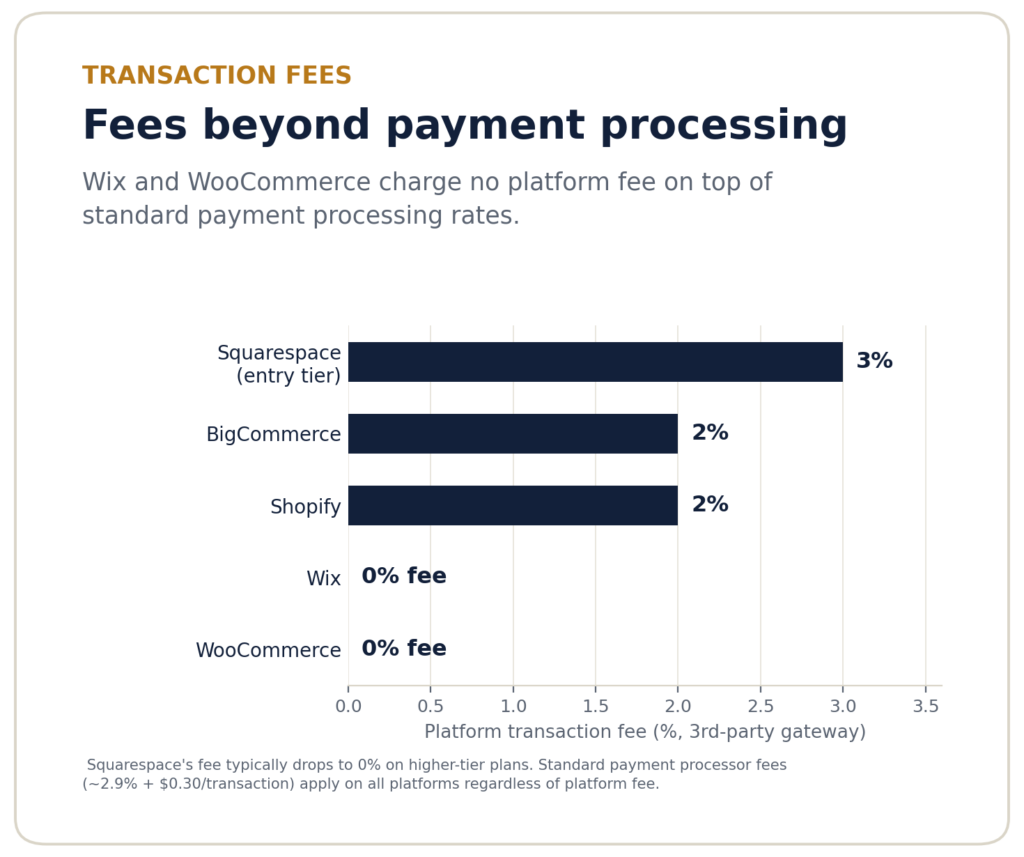
Wix and WooCommerce charge no platform fee on top of standard payment processing rates.
How to Choose the Right Platform
Weigh Setup Speed Against Long-Term Cost
Shopify, Wix, and Squarespace all get you selling faster than WooCommerce, because you’re not assembling hosting and plugins yourself. That speed has a price attached to it every month, indefinitely. WooCommerce’s lower long-term cost only pays off if you’re willing to spend the setup time WordPress requires, or pay someone else to do it once.
Match the Platform to Your Catalog and Channel Plans
If you already know you’ll sell across Amazon, eBay, or social channels alongside your own site, BigCommerce’s native multichannel support is worth weighing seriously before you build on a platform that requires third-party apps to get there. If your store is design-heavy or content-driven, Wix or Squarespace’s design tools may save you more time than a more commerce-focused platform would.
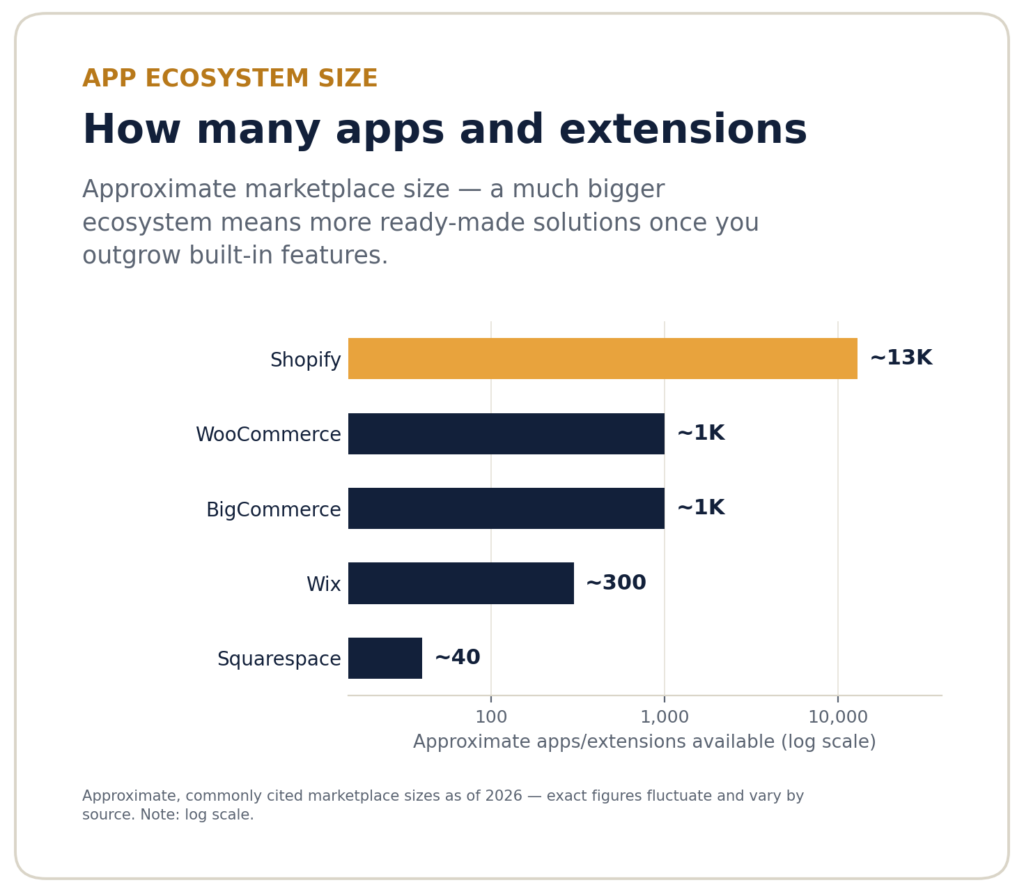
Approximate marketplace size — a much bigger ecosystem means more ready-made solutions once you outgrow built-in features.
Frequently Asked Questions
What Is the Best E-Commerce Platform for a Small Business on a Tight Budget?
WooCommerce is generally the cheapest over a full year, since the software itself is free and you’re only paying for hosting and a domain. If you want a faster setup without WooCommerce’s technical overhead, Wix’s Core plan and Squarespace’s entry e-commerce tier are both reasonably priced starting points.
Is Shopify Worth It for a Small Business?
For most small businesses, yes — the flat monthly fee buys you hosting, security, PCI compliance, and the largest app ecosystem of any platform here, which saves real setup time compared to assembling those pieces yourself on WooCommerce.
Which Platform Is Best for Selling on Amazon and Other Marketplaces Too?
BigCommerce has the strongest native multichannel selling built into its core plans, covering Amazon, eBay, and social channels without needing as many third-party apps as Shopify typically requires for the same functionality.
Do Wix and Squarespace Charge Transaction Fees Like Shopify?
It varies by platform and tier. Wix charges no platform transaction fees on its e-commerce plans. Squarespace charges a percentage fee on lower-tier plans, which typically drops to 0% once you’re on a higher tier — worth checking current terms directly, since exact tier structures have changed recently on both platforms.
Bottom Line: Choosing the Best E-Commerce Platform for Your Small Business
Bottom Line
There’s no universally best e-commerce platform for small business — only the one that fits your specific budget, technical comfort, and catalog plans. Shopify remains the safest default for most new sellers, WooCommerce rewards those willing to trade setup time for lower long-term cost, and Wix, Squarespace, and BigCommerce each have genuine, specific strengths worth matching to your actual situation rather than picking based on brand recognition alone.
Once you’ve settled on a platform, our complete guide to starting an online store walks through the software, AI tools, and financing decisions that come next.
Picked a platform and have real numbers to share? Email us at contact@ecomfundingguide.com — we read every message.
Pricing and features were current as of publication and may change — confirm current details directly on each platform’s site before committing.
How We Evaluated These Platforms
We compare current, publicly listed pricing directly from each provider’s official site, and weigh the following when ranking picks:
Pricing and features were current as of publication and may change — confirm current details directly on each platform’s site before committing.