This post contains affiliate links. If you sign up for a product through one of these links, we may earn a commission at no extra cost to you. See our Affiliate Disclosure for details.
Inventory financing exists to solve one specific, common problem: you have to pay for stock weeks or months before you see a dollar back from selling it. This guide walks through the actual types of inventory financing available to online sellers, what lenders require, and the real step-by-step process to get approved — sourced from lender documentation, not marketing copy. These are the 5 best ways how to get inventory financing for your online store, and exactly how to apply for each.
Key Takeaways
- Inventory financing isn’t one product — it ranges from bank lines of credit (cheapest, hardest to qualify for) to merchant cash advances (fastest, most expensive).
- Most lenders want at least 6–12 months in business and a documented sales history before approving inventory financing; newer stores have fewer options.
- Typical documentation includes an inventory list, business bank statements, tax returns, and a sales forecast — prepare these before you apply, not after.
- Revenue-based/sales-driven financing (built specifically for e-commerce sellers) has emerged as a middle ground: faster and more accessible than a bank loan, generally cheaper than a merchant cash advance.
- Always convert any fee or factor rate to an effective APR before comparing offers — a low-sounding fee over a short repayment term can cost more annually than a higher-sounding rate over a longer one.
Jump to a section
Short Answer: Fastest Path to Inventory Financing
For most online sellers with at least 6 months of sales history, sales-driven/revenue-based inventory financing for your online store (offered by providers like Onramp Funds) is the fastest realistic path — approval is based on your actual sales data rather than a credit score, and funding often arrives within days. If you qualify for a bank-backed inventory line of credit, it’s genuinely the cheapest option, but expect a slower approval process and a higher bar for time in business and revenue. Avoid merchant cash advances unless every other option has been exhausted — they’re fast, but the effective cost is dramatically higher than every alternative covered here.
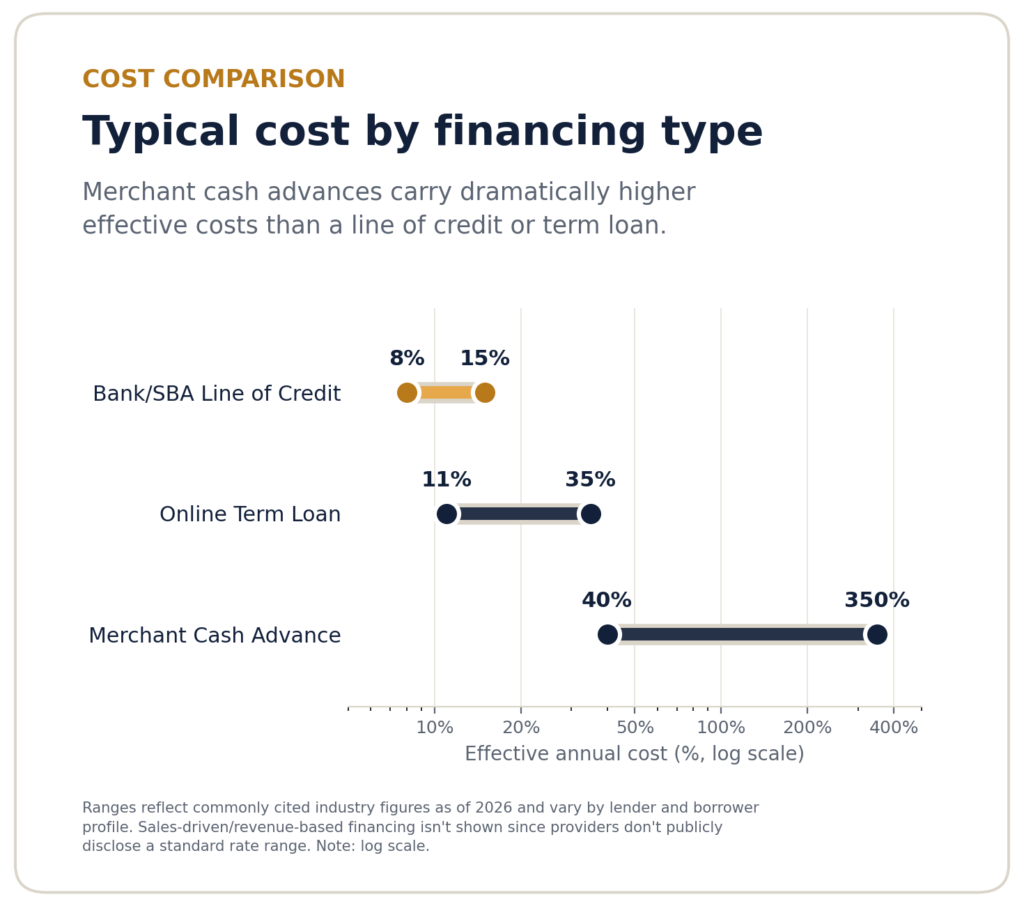
Merchant cash advances carry dramatically higher effective costs than a bank line of credit or online term loan — often 10-20x higher on an annualized basis.
What Inventory Financing Actually Is
Inventory financing is a loan or line of credit used specifically to purchase stock, often secured by the inventory itself or by your business’s sales performance. Instead of draining your cash reserves to restock, you borrow against future sales, repay as inventory sells, and free up working capital for everything else your store needs.
The Main Types of Inventory Financing
Inventory Line of Credit
A revolving credit facility you draw from as needed, paying interest only on what you actually use — then repay and borrow again without reapplying. Credit limits commonly range from $1,000 to $250,000. This tends to be the most flexible and cost-effective option for sellers who restock continuously rather than needing one large lump sum.
Online Term Loan
A lump-sum loan repaid over a fixed schedule, offered by online lenders like OnDeck or Funding Circle. Loan amounts typically range from $5,000 to $500,000, with interest rates commonly cited between 11% and 35% depending on credit profile and revenue. Funds can arrive faster than a traditional bank loan, though still slower than sales-driven financing.
Revenue-Based / Sales-Driven Financing
Built specifically for e-commerce sellers on platforms like Shopify, Amazon, or WooCommerce, this model bases approval on actual sales data rather than credit score or collateral, with repayment that flexes automatically alongside revenue. It’s positioned as a middle ground between a bank loan’s low cost and an MCA’s speed.
Purchase Order (PO) Financing
Designed for a specific scenario: you’ve received a large purchase order (often from a major retailer) but don’t have the cash to fulfill it. The lender advances funds — commonly 50–80% of the wholesale cost of the goods — directly tied to that order, repaid over a fixed term, often 3 to 12 months.
Vendor Financing
The lender pays your supplier directly so production or a seasonal inventory build doesn’t stall, and you repay over a short window — commonly 30 to 90 days — once the stock starts moving.
Merchant Cash Advance (Use With Caution)
An advance repaid through a percentage of future sales, funded quickly with minimal underwriting. The tradeoff is real: effective annual costs are commonly cited in the 40%–350% range, making this the most expensive option covered here by a wide margin.
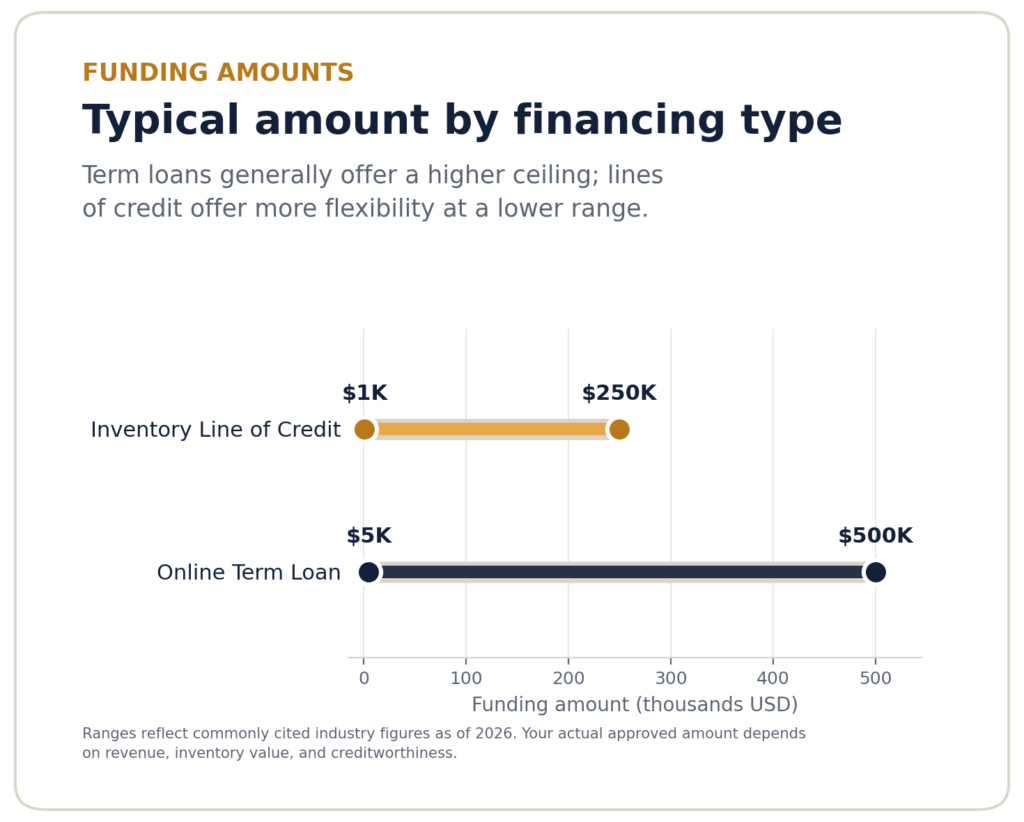
Term loans generally offer a higher funding ceiling, while lines of credit offer more flexibility to draw only what you need at a given time.
How to Get Inventory Financing: Step by Step
Step 1: Calculate How Much You Actually Need
Base this on your sales volume, upcoming seasonal demand, and current market trends — not a round number. The amount you request shapes which lenders and products are even a fit.
Step 2: Check Your Eligibility
Most lenders look for at least 6–12 months in business (some ask for 1–2 years), a documented sales history, and — depending on the lender — a minimum annual revenue threshold. Businesses with less than a year of operating history will find far fewer options, often limited to sales-driven financing or an MCA.
Step 3: Gather Your Documentation
Prepare these before you apply, since assembling them after slows every subsequent step: an inventory list (with estimated resale value), business bank statements, business tax returns, and a sales forecast or projection. Some lenders also request a formal business plan and aging accounts receivable/payable reports. The right inventory management tool makes documentation easy.
Step 4: Compare Lenders on More Than Rate
Look at approval speed, minimum time-in-business requirements, whether they have experience in your specific industry, and the full cost once fees are converted to an effective APR — not just the headline rate.
Step 5: Submit Your Application
Most online lenders now offer a fully digital application. You’ll submit your financial documentation alongside basic business information; a specialty inventory lender or sales-driven provider will typically connect directly to your store and payment platform to verify sales data automatically.
Step 6: Go Through Due Diligence
Once a lender confirms you’re eligible, expect a due diligence period where they verify your financial and inventory records in more depth before finalizing terms. This step is typically faster with online and sales-driven lenders than with a traditional bank.
Step 7: Receive Funding and Begin Repayment
Online and alternative lenders can often fund within days; banks typically take several weeks. Repayment structure depends on the product — a line of credit resets as you repay, a term loan follows a fixed schedule, and sales-driven financing adjusts automatically with your revenue.
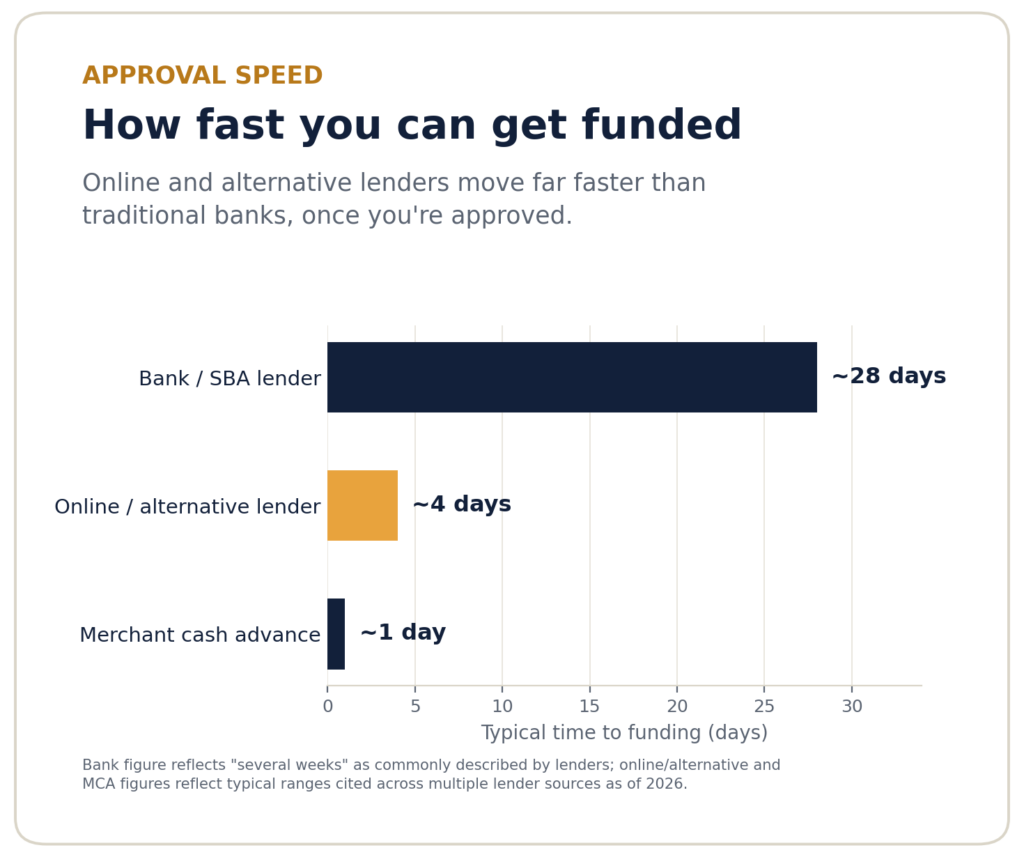
Online and alternative lenders typically fund in days rather than the several weeks a traditional bank or SBA lender requires.
Frequently Asked Questions
How Fast Can I Get Inventory Financing?
Online and sales-driven lenders can often fund within a few days once approved; traditional banks typically take several weeks. Merchant cash advances are the fastest of all, sometimes funding same-day, but at a significantly higher cost.
Do I Need Good Credit to Get Inventory Financing?
Not always. Sales-driven/revenue-based financing bases approval primarily on your store’s actual sales performance rather than personal credit score, which is why it’s more accessible to newer or credit-limited sellers than a bank line of credit or SBA-backed loan.
Can a Brand-New Store Get Inventory Financing?
It’s difficult. Most lenders want at least 6–12 months of sales history, and some require a full year or more. A brand-new store with no sales record will find very few realistic options and should expect higher costs if approved at all.
What’s the Difference Between Inventory Financing and a Merchant Cash Advance?
Inventory financing is typically tied specifically to purchasing stock and often uses that inventory (or your sales data) to determine terms, generally at a lower cost. A merchant cash advance is a broader cash advance repaid via a percentage of daily sales, usable for any purpose, funded fast but at a meaningfully higher effective cost.
Bottom Line: Getting Inventory Financing for Your Online Store
Bottom Line
Start by matching the financing type to your actual situation: an inventory line of credit if you restock continuously and can qualify, sales-driven financing if you want speed and accessibility without an MCA’s cost, and PO or vendor financing if you’re solving one specific large order or seasonal build. Whatever you choose, gather your documentation before you apply, and convert every offer to an effective APR so you’re comparing real costs, not headline numbers.
If you’re also weighing general working capital options alongside inventory-specific financing, see our guides on Shopify Capital vs. Clearco and our complete guide to e-commerce financing options.
Used inventory financing for your online store and have real numbers to share? Email us at contact@ecomfundingguide.com — we read every message.
This article is for informational purposes only. Rates, terms, and eligibility requirements vary by lender and change over time — confirm current details directly with any lender before applying, and consider consulting a financial advisor before taking on financing.
How We Researched This Guide
We cross-referenced eligibility, cost, and speed figures across multiple lender sources rather than relying on a single provider’s marketing claims. We weighed:
This article is for informational purposes only. Rates, terms, and eligibility requirements vary by lender and change over time — confirm current details directly with any lender before applying, and consider consulting a financial advisor before taking on financing.