This post contains affiliate links. If you sign up for a product through one of these links, we may earn a commission at no extra cost to you. See our Affiliate Disclosure for details.
Writing product descriptions one by one doesn’t scale past a few dozen SKUs, and generic chatbots weren’t built for the specific job — matching platform character limits, staying on-brand across hundreds of products, and actually helping pages rank in search. That’s the gap AI tools for writing product descriptions are built to close: purpose-built software that turns a product title, a handful of features, or even just a photo into publish-ready copy in seconds, at whatever scale your catalog actually needs.
This guide compares the best AI tools for writing product descriptions in 2026, from Shopify’s free built-in option to dedicated platforms built for catalogs running into the thousands of SKUs. We looked at pricing, how each tool actually generates copy, and — critically — who each one is genuinely built for, since the right AI product description tool for a 20-SKU Etsy shop looks nothing like the right one for a multi-channel retailer.
Key Takeaways
- Best free option: Shopify Magic is a genuinely capable AI writing tool included with every Shopify plan — no separate app or subscription needed.
- Best for large catalogs: Describely.ai and Hypotenuse AI are both AI tools purpose-built for bulk generation across hundreds of SKUs, not one-off writing sessions.
- Best for Amazon sellers: Scalenut’s AI automatically keeps descriptions within each marketplace’s character limits and shows the keyword data behind its suggestions.
- Best truly free option beyond Shopify: Ahrefs’ AI Product Description Generator works from a photo with no subscription required.
- Don’t publish AI-written product copy unedited — platforms and shoppers can both tell, and unedited generic AI output is a weaker SEO signal than human-reviewed copy.
Jump to a tool
Short Answer: Best AI Tools for Writing Product Descriptions
If you’re on Shopify, start with Shopify Magic — it’s a free, genuinely useful AI tool built into your admin, and good enough for most stores under a few hundred SKUs. If you’re managing a large, multi-channel catalog, Describely.ai’s pay-as-you-go AI pricing and Hypotenuse AI’s bulk import features are built specifically for that scale. Amazon-focused sellers should look at Scalenut for its marketplace-aware character limits and built-in keyword research. Across every option here, the AI does the first draft — you still need to review it before it goes live.
The Best AI Tools for Writing Product Descriptions
Shopify Magic
Free and built directly into every Shopify plan, Shopify Magic is Shopify’s own AI content tool, generating a full product description from a product title and a few key features, with a choice of tone — expert, persuasive, playful, supportive, daring, or sophisticated. It works entirely inside your Shopify admin, so there’s no separate app to install and no second login to manage; you click the “Generate description” icon wherever it appears in your product editor, and the AI drafts copy in seconds using the product data you’ve already entered. For merchants adding dozens of new SKUs from a supplier feed, this speed advantage is real — you can move through an entire batch of new products in under an hour without leaving Shopify.
The tradeoff: output control is more limited than a dedicated AI writing platform, and complex, spec-heavy products (technical equipment, multi-variant items with dozens of attributes) don’t always generate cleanly without hands-on editing. Shopify Magic’s text generation also currently requires a desktop browser rather than mobile, according to Shopify’s own documentation, so plan your content sessions accordingly.
Hypotenuse AI
Built specifically for e-commerce catalogs rather than general copywriting, Hypotenuse AI can import your entire product list from Shopify or a CSV file and generate descriptions in bulk — including directly from a product photo, which matters when you’re missing full written specs from a supplier. The AI reads the product category context and applies e-commerce-appropriate structure and keyword placement automatically, rather than producing generic marketing filler. Pricing starts at $19/month for 50,000 words, with a 7-day free trial that includes full access to content generation, making it a low-risk way to test whether the output quality fits your brand voice before committing.
Describely.ai
A pay-as-you-go AI platform built for catalog operations rather than occasional writing tasks, Describely generates product titles, full descriptions, bullet points, tags, and meta descriptions together in a single pass, and can also fill in missing product attributes when your source data is incomplete. Pricing runs $0.75 per product and $0.55 per enrichment credit, with no subscription or seat fees — cost scales directly with how many products you’re actually processing rather than penalizing you for catalog growth the way a flat monthly plan can. This structure makes Describely’s AI a strong fit specifically for retailers and distributors managing 100 or more SKUs who need consistent, on-brand copy without maintaining a full-time writing team.
Copy.ai
A general-purpose AI writing platform that includes product description generation as one feature among a much broader toolkit — ad copy, email campaigns, social posts, and more. If you want a single AI subscription that covers your product pages alongside the rest of your marketing content, Copy.ai is a reasonable consolidation play. It’s less e-commerce-specialized than a dedicated catalog tool like Describely or Hypotenuse, so it doesn’t offer the same native Shopify/CSV bulk-import workflow — you’ll generally be working product-by-product or through custom templates rather than a true batch pipeline.
Scalenut
Built with SEO and marketplace formatting specifically in mind, Scalenut’s AI generates four description variants per run so you can compare options rather than accepting a single output, and automatically keeps copy within platform-specific character limits — Amazon’s roughly 300-word guidance and Shopify’s typical 300-to-400-word range, for example. Each suggestion comes with the underlying keyword and search intent data behind it, so you’re working from real search signal rather than guessing at what to emphasize. The tradeoff is a steeper learning curve than a single-purpose generator, since Scalenut is really a full content workspace that product description generation lives inside of.
Ahrefs Product Description Generator
A free AI tool from Ahrefs that generates a description directly from an uploaded product photo, plus a few selected features and a tone setting. There’s no cost and no account requirement to try it, which makes it a genuinely useful option for testing AI-written product copy before committing to a paid tool. The limitation: outputs can’t be saved or organized within the tool itself, so you’ll copy each result out manually rather than managing a queue of generated descriptions.
How to Choose the Right AI Tool for Your Catalog
Match the Tool to Your Catalog Size
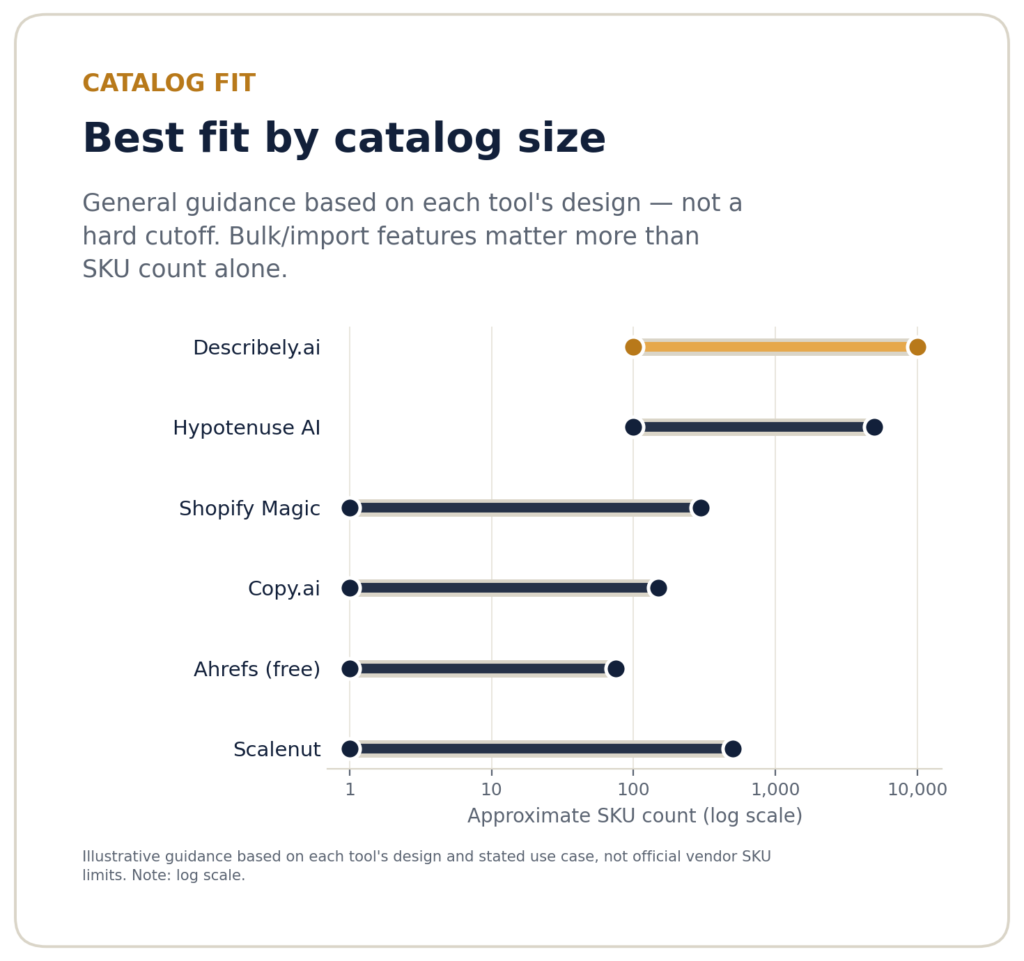
An AI tool built for one-off writing — Copy.ai, or Ahrefs’ free generator — works fine for a small catalog where you’re generating a handful of descriptions a week. That same workflow becomes a real bottleneck past a few hundred SKUs — often around the same point where the right inventory management tool becomes worth adopting too — which is exactly when a bulk-import, catalog-native AI platform like Describely or Hypotenuse starts to pay for itself in time saved rather than just cost.
Always Edit AI-Generated Copy Before Publishing
AI-written product descriptions that you’ve reviewed and edited for accuracy are treated normally for SEO purposes — search engines evaluate content quality, not whether AI was involved in the first draft. Unedited, generic AI output is the actual risk: it reads as filler to both shoppers and search engines, and it’s exactly the kind of thin, undifferentiated content that tends to underperform. Budget real editing time into your workflow, not just generation time.
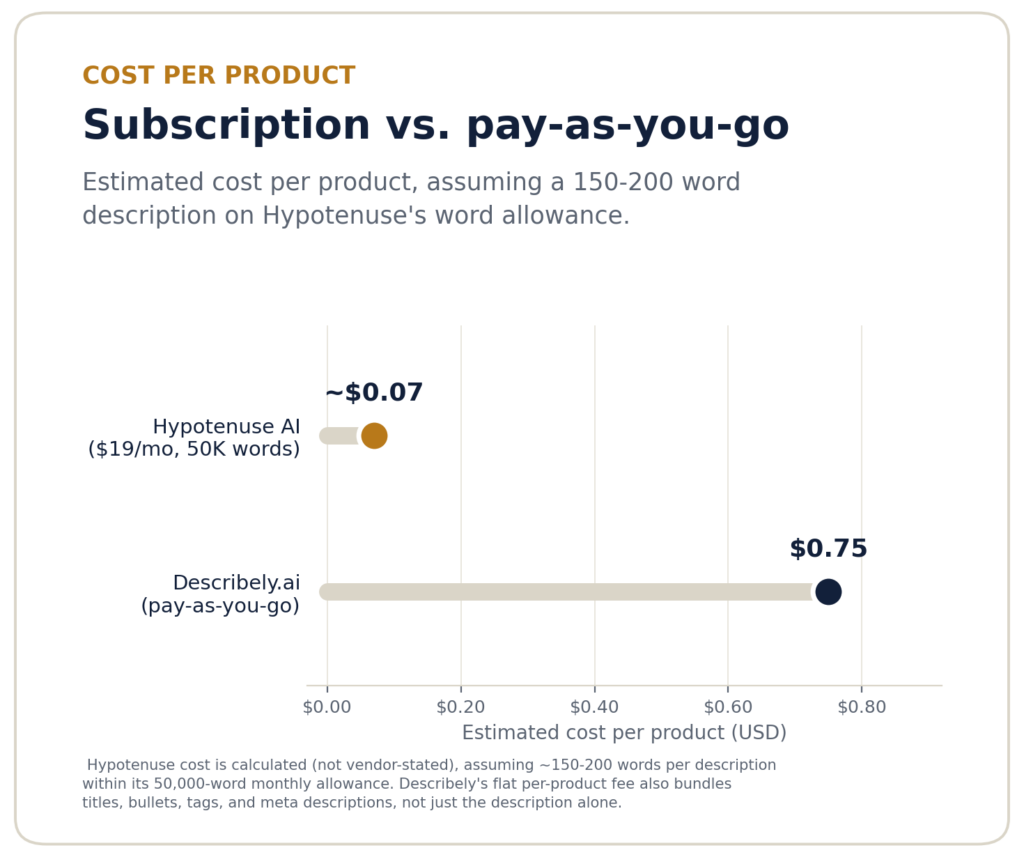
Hypotenuse’s subscription works out to a few cents per product at typical description length, while Describely’s flat per-product fee bundles more than just the description alone.
Frequently Asked Questions
Is Shopify Magic Good Enough, or Do I Need a Separate AI Tool?
For most stores under a few hundred SKUs, Shopify Magic is a genuinely capable, free AI writing tool and there’s little reason to pay for something separate. Consider a dedicated AI platform once you’re managing a large multi-channel catalog, need true bulk CSV import and generation, or want more control over output formatting and tone than Shopify Magic currently offers.
Will Google Penalize AI-Generated Product Descriptions?
Not inherently — Google has publicly stated it evaluates content quality, not whether AI was involved in producing it. The actual risk is unedited, generic AI text that reads as filler regardless of how it was written; product descriptions generated by AI and then reviewed and edited by a person are treated the same as any other content for ranking purposes.
How Much Do AI Tools for Writing Product Descriptions Cost?
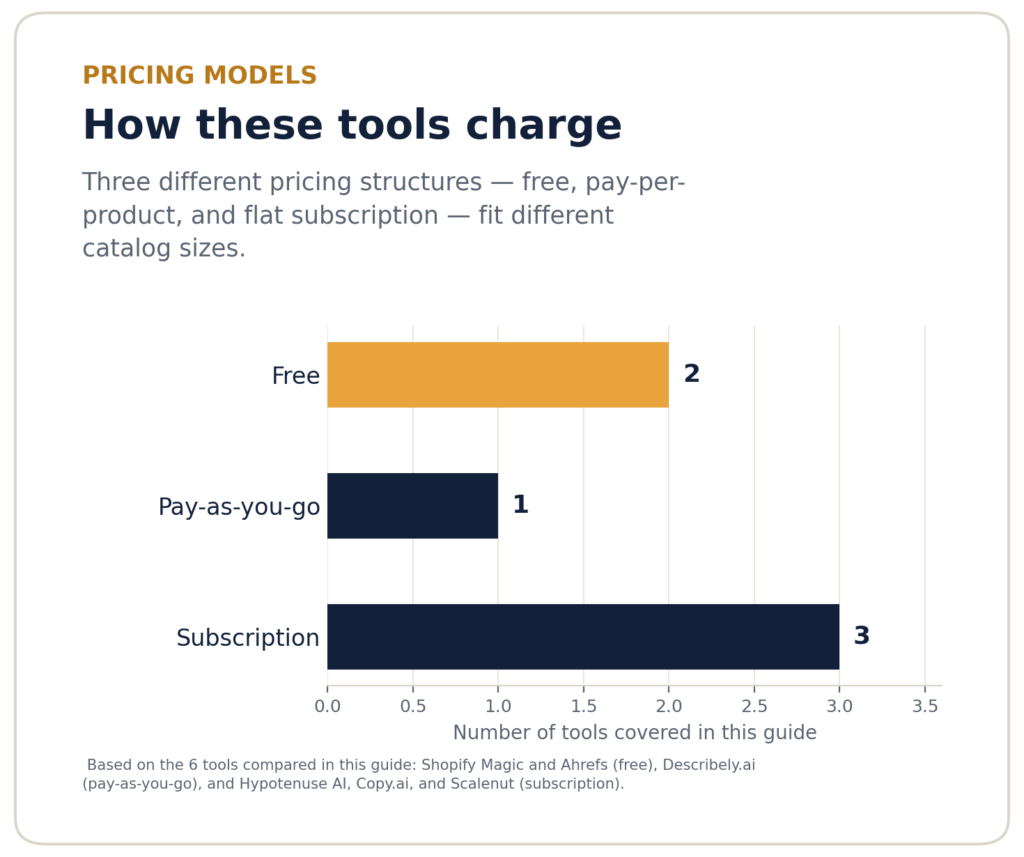
Options range from completely free (Shopify Magic, Ahrefs’ generator) to pay-as-you-go AI pricing (Describely.ai, roughly $0.75 per product) to subscription-based bulk tools starting around $19/month for a set word allowance (Hypotenuse AI). Realistic cost scales mainly with catalog size and how much bulk automation you actually need, not with how “good” the underlying AI is.
Can These AI Tools Generate Descriptions From Just a Product Photo?
Yes — several of the tools covered here support this directly. Both Hypotenuse AI and Ahrefs’ free generator can produce a full product description from an uploaded photo plus a few selected details, which is genuinely useful when you’re missing complete written specs from a supplier and don’t want to write every attribute by hand.
Bottom Line: Choosing an AI Tool for Writing Product Descriptions
Bottom Line
Start with Shopify Magic if you’re on Shopify and managing a smaller catalog — it’s a capable free AI tool, and there’s no reason to pay before your catalog actually outgrows it. Move to a dedicated AI platform like Describely or Hypotenuse once SKU volume makes one-by-one generation genuinely impractical, and consider Scalenut specifically if Amazon is a major sales channel for your store. Whichever AI tool you choose, treat its output as a strong first draft rather than a finished product — the human editing step is what keeps both search engines and shoppers trusting your product pages.
If you’re building out your store’s AI stack further, see our guides on the best AI chatbots for Shopify and AI inventory forecasting tools.
Found an AI tool for writing product descriptions that works well for your catalog? Email us at contact@ecomfundingguide.com — we read every message.
Pricing and features were current as of publication and may change — confirm current details directly on each provider’s site before subscribing.
How We Evaluated These Tools
We linked directly to each provider’s own product or pricing page rather than third-party roundups, and cross-checked pricing claims where sources disagreed. We weighed:
Pricing and features were current as of publication and may change — confirm current details directly on each provider’s site before subscribing.