This post contains affiliate links. If you sign up for a product through one of these links, we may earn a commission at no extra cost to you. See our Affiliate Disclosure for details.
A business line of credit is one of the most flexible financing tools available to an online store, but flexibility isn’t free — and it isn’t automatically the right tool for every situation. This guide walks through how a business line of credit actually works, what it costs by lender type, and — more importantly — when it’s genuinely the right call versus when a different financing option fits your store better.
Key Takeaways
- A business line of credit is revolving, not a lump sum: you draw what you need, repay it, and can draw again — paying interest only on what you’ve actually used.
- Rates vary enormously by lender type: roughly 8–14% APR at banks, 10.5–14.5% at SBA-backed lenders, and 20–60%+ at online lenders, depending heavily on your credit profile.
- Bank lines require the most to qualify (typically 2+ years in business, 700+ credit score) but cost the least; online lines approve faster and with lower requirements, at a real cost premium.
- A line of credit is genuinely useful for smoothing cash flow gaps and having a safety net — it’s usually the wrong tool for funding one large inventory order or an entirely new store with no sales history.
- Lines of credit are reviewed annually — strong performance can expand your limit, while declining revenue can shrink or freeze it, so it’s a relationship product, not a one-time transaction.
Jump to a section
Short Answer: Do You Need a Business Line of Credit?
If your store has predictable cash flow gaps — slow months before a seasonal spike, timing mismatches between when you pay suppliers and when customer payments clear — a business line of credit is genuinely one of the best tools available, since you only pay for what you actually draw. If you need a large, one-time sum for a specific inventory order or are just starting out with no sales history, a line of credit likely isn’t your best first option; purchase order financing, revenue-based financing, or Shopify Capital may fit better. This guide walks through both cases.
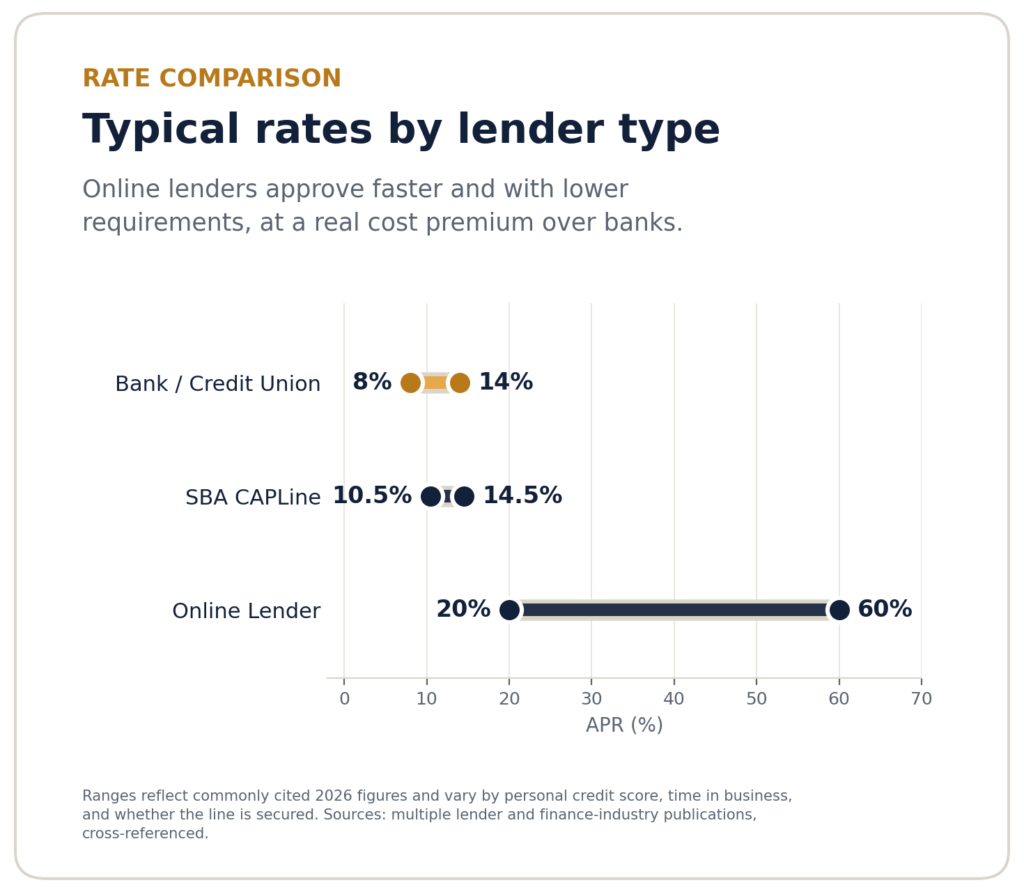
Online lenders approve faster and with lower requirements, at a real cost premium over banks.
What Is a Business Line of Credit?
A business line of credit is revolving credit: you’re approved for a maximum limit, and you can draw any amount up to that limit, repay it, and draw again — similar in structure to a credit card, but typically at a lower rate and with a business-specific credit limit. Interest is charged only on the amount you’ve actually drawn, not your full approved limit, which is the core difference from a term loan that hands you a lump sum upfront with a fixed repayment schedule regardless of whether you need all of it immediately.
For an online store, this structure maps naturally onto the actual shape of the cash flow problem: you don’t need $50,000 sitting unused for eleven months a year, you need access to it during the specific weeks when supplier payments and ad spend outpace incoming revenue.
When a Line of Credit Makes Sense
Your Cash Flow Has Predictable Gaps
If you can point to a recurring pattern — a slow season before your busiest quarter, a lag between paying for inventory and collecting from customers — a line of credit is built exactly for this. You draw during the gap and repay once revenue catches up, rather than taking on a fixed loan sized for your worst month year-round.
You Want a Safety Net, Not a Specific Purchase
A line of credit is a strong fit when the goal is having capital available “just in case” rather than funding one identified expense. Unlike a term loan or purchase order financing, there’s no requirement to draw the full amount, or draw it at all — you’re paying for access, not for cash you’re not using.
You Qualify for Bank-Level Rates
If your store has 2+ years of operating history, strong personal credit (700+), and consistent revenue, you’re in range for a bank or SBA-backed line at 8–14.5% APR — genuinely cheap capital that’s worth having in place even if you don’t draw on it immediately.
When You Might Not Need One
You Need Money for One Big Inventory Order
If you’re solving a single, specific problem — funding one large purchase order or a seasonal inventory build — dedicated financing built for that scenario often costs less and fits better than a general-purpose line. See our complete guide to getting inventory financing for options built specifically for this case.
You’re Shopify-Native and Haven’t Checked Your Options
Before applying for a line of credit, check whether you already have an offer from Shopify Capital, or compare it against Shopify Capital vs. Clearco — both can be faster to access than a bank line, with no separate application in Shopify Capital’s case.
You Don’t Have Steady Revenue Yet
Lines of credit are underwritten heavily on revenue consistency and time in business. A brand-new store without a sales history will struggle to qualify for a meaningful line at a reasonable rate, and may be better served by a smaller, more accessible financing option while building that track record. Our complete guide to e-commerce financing options covers the wider landscape if a line of credit isn’t the right fit yet.
How to Get a Business Line of Credit: Step by Step
Step 1: Check Which Lender Category You Realistically Qualify For
Bank and SBA-backed lines require roughly 2+ years in business and a 700+ personal credit score for the best rates. Online lenders typically approve down to 1 year in business and a 600–680+ credit score, at a meaningfully higher rate. Knowing which category you fit avoids wasting time applying to a tier you won’t qualify for.
Step 2: Gather Your Financial Documentation
Lenders will want business bank statements, tax returns, and revenue history at minimum; banks and SBA-backed lenders typically ask for more extensive documentation than online lenders, in exchange for their lower rates.
Step 3: Compare Total Cost, Not Just the Headline Rate
Look at the full APR, not just an advertised starting rate, and check for draw fees, maintenance fees, or early closure fees that can add real cost on top of interest.
Step 4: Apply and Expect a Real Underwriting Process
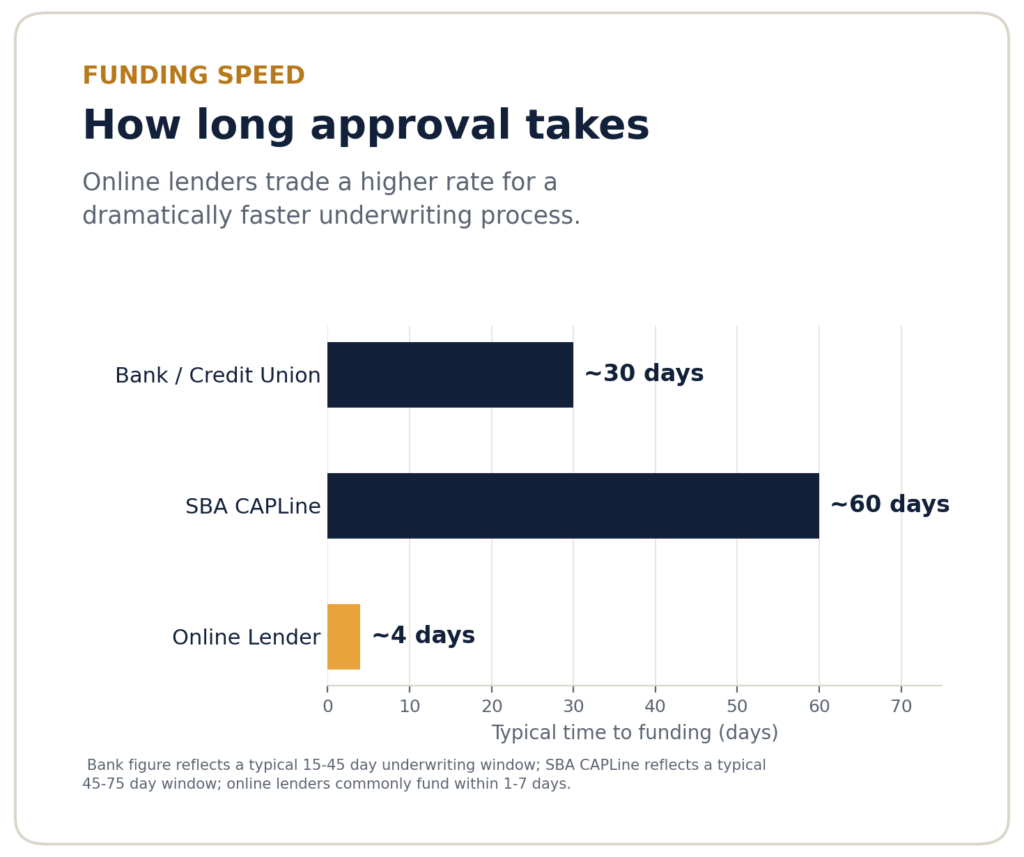
Bank and SBA-backed lines typically take 15–45 days to fund; online lenders can often approve and fund within 1–7 days. If you need capital faster than any line of credit can realistically provide, that’s a signal you may need a different financing product entirely for this specific need.
Step 5: Understand That Your Line Gets Reviewed Annually
Lines of credit are typically reviewed each year — strong revenue and on-time repayment can expand your limit, while declining performance can shrink or freeze it. Treat it as an ongoing relationship with the lender, not a one-time transaction.
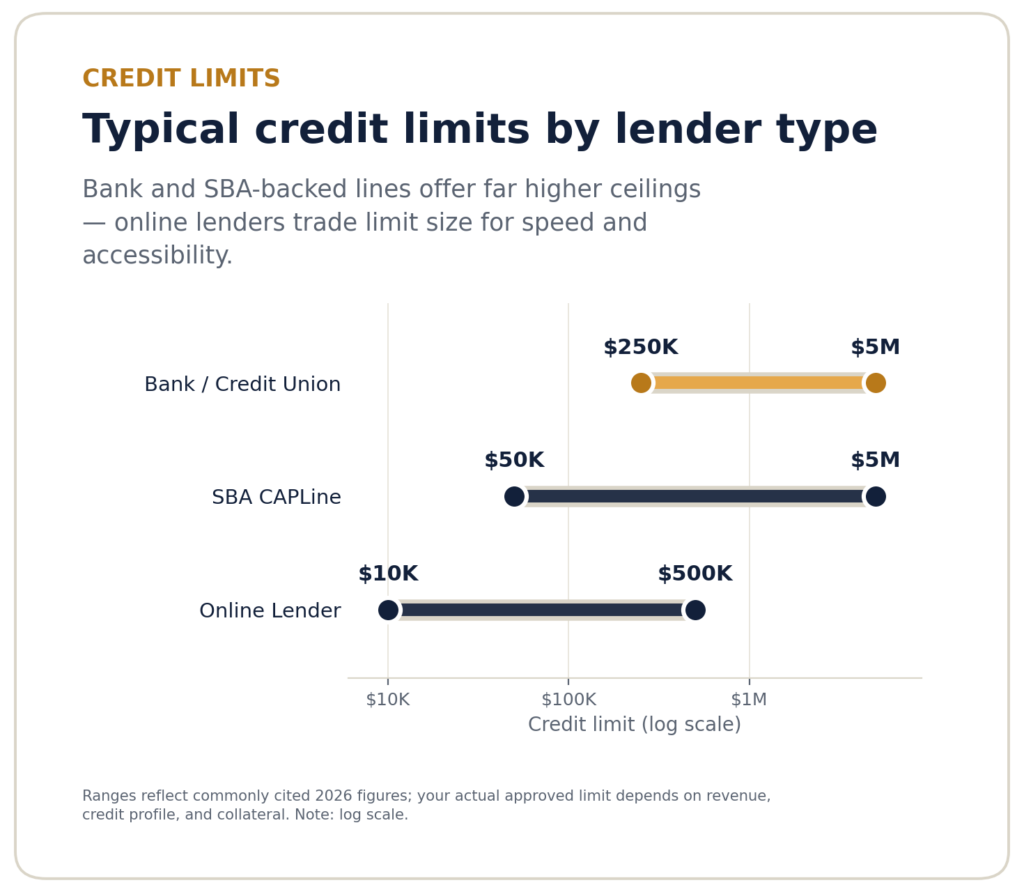
Bank and SBA-backed lines offer far higher ceilings — online lenders trade limit size for speed and accessibility.
Frequently Asked Questions
Is a Business Line of Credit Better Than a Business Loan?
Neither is universally better — they solve different problems. A line of credit is better for ongoing, variable cash flow needs where you don’t know exactly how much you’ll need or when; a term loan is better when you know the exact amount you need for a specific purpose, like a large equipment purchase or inventory order.
How Much Does a Business Line of Credit Cost?
Rates run roughly 8–14% APR at traditional banks, 10.5–14.5% APR through SBA-backed CAPLine products, and commonly 20–60%+ APR at online lenders, depending heavily on your personal credit score and time in business — a jump from a 650 to 720 credit score can meaningfully lower an online lender’s rate.
Can a New E-Commerce Store Get a Business Line of Credit?
It’s difficult but not impossible. Most lenders want at least a year of operating history and consistent revenue; online lenders are generally more accessible to newer businesses than banks, though at a higher rate. A brand-new store with no sales history will likely need to consider other financing options first.
Does Applying for a Line of Credit Hurt My Credit Score?
It can cause a small, temporary dip from the hard credit inquiry most lenders run during underwriting, similar to applying for any other financing. Many online lenders offer a rate check that uses only a soft pull, letting you see estimated terms before a hard inquiry — worth asking about before formally applying to multiple lenders at once.
Bottom Line: Should You Get a Business Line of Credit?
Bottom Line
A business line of credit is genuinely one of the best financing tools available for an online store with predictable cash flow gaps and at least some operating history — you pay only for what you draw, and having one in place before you need it is far better than applying under pressure. It’s the wrong tool if you’re solving a single large, specific expense, or if your store is too new to show the revenue consistency lenders want to see. Compare your realistic rate across bank, SBA, and online lenders before committing, and read the full terms for draw fees and annual review conditions, not just the advertised APR.
If a line of credit doesn’t fit your situation, see our guides on inventory financing and Shopify Capital vs. Clearco for other paths to working capital.
Used a business line of credit for your store and have real numbers to share? Email us at contact@ecomfundingguide.com — we read every message.
This article is for informational purposes only and isn’t financial advice. Rates, terms, and eligibility requirements vary by lender and change over time — confirm current details directly with any lender before applying, and consider consulting a financial advisor before taking on financing.
How We Researched This Guide
We cross-referenced rate, speed, and credit-limit figures across bank, SBA, and online lender sources rather than relying on a single provider’s marketing claims. We weighed:
This article is for informational purposes only and isn’t financial advice. Rates, terms, and eligibility requirements vary by lender and change over time — confirm current details directly with any lender before applying, and consider consulting a financial advisor before taking on financing.